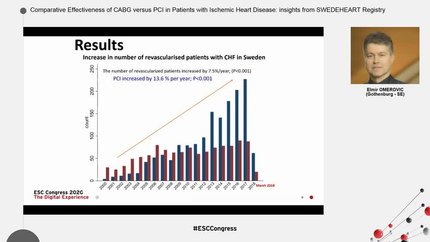
Long-term mortality in patients with ischaemic heart failure revascularized with coronary artery bypass grafting or percutaneous coronary intervention: insights from the Swedish Coronary Angiography and Angioplasty Registry (SCAAR)
European Heart Journal


Abstract
To compare coronary artery bypass grafting (CABG) and percutaneous coronary intervention (PCI) for treatment of patients with heart failure due to ischaemic heart disease.
We analysed all-cause mortality following CABG or PCI in patients with heart failure with reduced ejection fraction and multivessel disease (coronary artery stenosis >50% in ≥2 vessels or left main) who underwent coronary angiography between 2000 and 2018 in Sweden. We used a propensity score-adjusted logistic and Cox proportional-hazards regressions and instrumental variable model to adjust for known and unknown confounders. Multilevel modelling was used to adjust for the clustering of observations in a hierarchical database. In total, 2509 patients (82.9% men) were included; 35.8% had diabetes and 34.7% had a previous myocardial infarction. The mean age was 68.1 ± 9.4 years (47.8% were >70 years old), and 64.9% had three-vessel or left main disease. Primary designated therapy was PCI in 56.2% and CABG in 43.8%. Median follow-up time was 3.9 years (range 1 day to 10 years). There were 1010 deaths. Risk of death was lower after CABG than after PCI [odds ratio (OR) 0.62; 95% confidence interval (CI) 0.41–0.96;
In patients with ischaemic heart failure, long-term survival was greater after CABG than after PCI.
Contributors

Sebastian Völz
Author
Björn Redfors
Author
Oskar Angerås
Author
Dan Ioanes
Author
Jacob Odenstedt
Author
Sasha Koul
Author
Inger Valeljung
Author


Emma Hansson
Author
Dimitrios Venetsanos
Author
Anders Ulvenstam
Author
Tomas Jernberg
Author
Truls Råmunddal
Author
Pétur Pétursson
Author
Ole Fröbert
Author

Anders Jeppsson
Author

You may be interested in