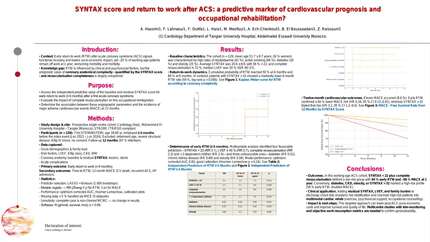
Factors influencing return-to-work after cerebrovascular disease: the importance of previous cardiovascular risk
European Journal of Preventive Cardiology


Abstract
The role of prior cardiovascular risk (CVR) in the multifactorial process of returning to work after a cerebrovascular event has not been adequately investigated. Therefore, the objective of the present study was to analyse the association between previous CVR level, cardiovascular risk factors (CVRFs) and return-to-work (RTW) following cerebrovascular disease.
This was a prospective observational study.
We analysed a cohort of 348 patients who had experienced an episode of cerebrovascular disease-related work absence. These individuals were selected from the ICARIA study (
We found that a total of 254 individuals (73.0%; 95% CI: 68.3–77.7) returned to work after cerebrovascular disease. Also, we observed a median loss of 12 working years due to disability. Moreover, adjusting for potential confounders revealed that low CVR level and the absence of the following CVRFs was associated with a higher likelihood of RTW: low vs moderate-to-high CVR level (OR: 2.55; 95% CI: 1.42–4.57), no hypertension before stroke (OR: 1.95; 95% CI: 1.11–3.41), non-smoker status (OR: 2.26; 95% CI: 1.30–3.93) and no previous diabetes (OR: 2.46; 95% CI: 1.26–4.79).
Low CVR, along with the absence of several CVRFs, can be used to predict RTW rates following cerebrovascular events. Therefore, controlling hypertension, tobacco consumption and diabetes might contribute to the effectiveness of multidisciplinary rehabilitation and/or secondary/tertiary prevention programs for cerebrovascular disease.
Contributors

Carlos Catalina-Romero
Author
Luis Miguel Ruilope
Author
Pedro Valdivielso
Author
Martha Cabrera-Sierra
Author
Carlos Fernández-Labandera
Author
Montserrat Ruiz-Moraga
Author
Arturo Gonzalez-Quintela
Author
Eva Calvo-Bonacho
Author
You may be interested in