Artificial intelligence-guided, single-lead EKG may be a game-changer for symptom-to-balloon time reduction in ST-elevated myocardial infarction
European Heart Journal


Abstract
Over decades, efforts to shave off life-saving minutes from ST-Elevated Myocardial Infarction (STEMI) care centred on reducing door-to-needle and door-to-balloon times. We firmly believe that symptom-to-balloon time should prove a better focus to this end. Challenges come with this goal as it heavily relies on a patient's perception and initiative to seek care, which we deem intelligent and wearable Artificial Intelligence (AI)-driven Single Lead EKG technologies as an attractive solution in modern-day cardiology.
To provide an accurate, accessible, and cost-effective AI-driven Single Lead STEMI detection algorithm that can be embedded into wearable devices and employed in a self-administered fashion.
Database: EKG records from Mexico, Colombia, Argentina, and Brazil from April 2014 to December 2019. Dataset: A total of 11,567 12-lead EKG records of 10[s] length with a sampling frequency of 500 Hz, including the following balanced classes: angiographically confirmed and unconfirmed STEMI, branch blocks, non-specific ST-T abnormalities, normal and abnormal (200+ CPT codes, excluding those mentioned above). Cardiologists manually checked the label of each record to ensure precision. Pre-processing: We discard the first and last 250 samples as they may contain a standardisation pulse. The study applied a digital low pass filter of order 5 with a frequency cut-off of 35 Hz. The mean was subtracted from each Lead. Classification: The determined classes were “STEMI” (Including STEMI in different locations of the myocardium – anterior, inferior, and lateral); and “Not-STEMI” (Combination of randomly sample, branch blocks, non-specific ST-T changes, and abnormal records – 25% of each). Training and Testing: A 1-D Convolutional Neural Network was trained and tested with a dataset proportion of 90/10, respectively. A different model was trained and tested for each Lead, using the central 4,500 samples of the records. The last dense layer outputs a probability for each report of being STEMI or Not-STEMI. Lead V2 showed the best overall results. The model was further tested through the same methodology using the best Lead with a subset of the previous data, excluding the unconfirmed STEMI EKG records (Total 7,230 12-lead EKG records for Confirmed Only STEMI dataset). Performance metrics were reported for each experiment and compared.
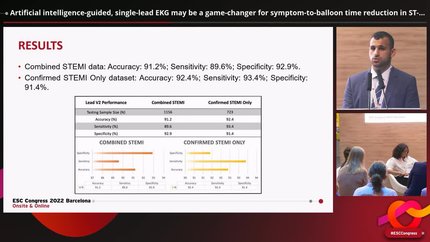
Combined STEMI data: Accuracy: 91.2%; Sensitivity: 89.6%; Specificity: 92.9%. Confirmed STEMI Only dataset: Accuracy: 92.4%; Sensitivity: 93.4%; Specificity: 91.4% (Figure 1).
By assiduously improving the quality of the model's input, we continue to assess our algorithm's performance and reliability for future clinical validation as a potential remote monitoring and early STEMI detection device.
Type of funding sources: None.
Figure 1
Contributors

S Mehta
Author
D Vieira
Author
V Guillen
Author
D Zerpa
Author
A Quintana
Author
C Sanchez
Author
S Ozair
Author
L Brena-Pastor
Author
D Pinos
Author
M Fleming
Author
K Carrera
Author
F Rossitto
Author
F Martinez
Author
A Gonzalez
Author
K Rodriguez
Author
You may be interested in