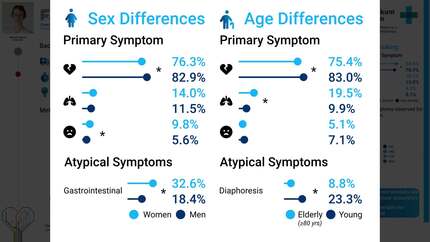
Mismatch of presenting symptoms at first and recurrent acute myocardial infarction. From the MONICA/KORA Myocardial Infarction Registry
European Journal of Preventive Cardiology


Abstract
It is unknown whether the symptoms of first and recurrent acute myocardial infarction (AMI) are similar in the same person. This study examined the frequency of symptom mismatch, which factors are associated with a symptom mismatch and how symptom mismatch is related to 28-day case fatality.
Observational study.
The sample consisted of 1282 persons with a first and recurrent AMI, recruited from a population-based AMI registry, 1985–2011. Occurrence of 11 symptoms was recorded in first and recurrent AMI using standardized patient interview. Logistic regression modelling adjusted for demographic and clinical variables was applied.
Mismatch was highest for dyspnoea (40.6%) and lowest for chest symptoms (10.4%). Compared with women, men were less likely to have a mismatch of pain between the shoulder blades (odds ratio (OR) 0.58, 95% confidence interval (CI) 0.43–0.79), pain in the throat/jaw (OR 0.67, 95% CI 0.50–0.91), nausea (OR 0.62, 95% CI 0.47–0.82), vomiting (OR 0.50, 95% CI 0.36–0.71), or fear of death (OR 0.71, 95% CI 0.53–0.94), or to have three or more mismatching symptoms (OR 0.60, 95% CI 0.45–0.79). Persons with diabetes were more likely to have a mismatch in chest symptoms, whereas persons with hyperlipidaemia or persons who received any revascularization therapy at first infarction were significantly less likely to have a mismatch of chest symptoms. Twenty-eight-day case fatality significantly increased with the number of mismatching symptoms (OR 1.14, 95% CI 1.02–1.28).
Patients with AMI may benefit from information about the possibility that a recurrent infarction may be associated with different symptoms.
Contributors

Inge Kirchberger
Author
Margit Heier
Author
Hildegard Golüke
Author
Bernhard Kuch
Author
Wolfgang von Scheidt
Author
Annette Peters
Author
Christa Meisinger
Author
You may be interested in