Relative monocytosis predicts the presence and severity of coronary artery disease on CT coronary angiography in patients with stable angina symptoms
European Heart Journal


Abstract
Monocytes, among other leucocytes, are crucially involved in the pathogenesis of atherosclerosis, but the value of peripheral blood leucocyte counts in predicting the presence or absence of atherosclerotic coronary artery disease (CAD) is unknown.
Investigating whether circulating counts of monocytes, lymphocytes and neutrophils predict CAD on computed tomography coronary angiography (CTCA) in patients presenting with stable chest pain.
All patients investigated with CTCA in our centre in the year 2021 were screened (n=1564). Patients presenting via the Rapid Access Chest Pain clinic were retrospectively identified, and those with a Full Blood Count from the 6 months prior to clinic were included (n=330). Traditional cardiovascular risk factors were ascertained from the clinic letter. CAD was defined as any epicardial stenosis >25% on CTCA. Patients with CAD were further classified as having either single or multivessel disease (left main stem disease was considered multivessel), and non-obstructive or obstructive disease (any stenosis >70% was considered obstructive).
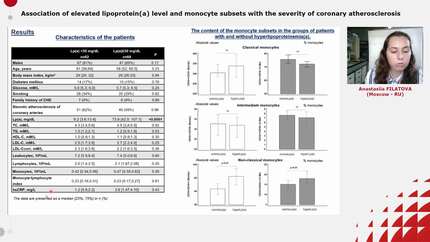
Patients with CAD had significantly higher mean monocyte count than those without CAD (0.61 vs. 0.55x10⁹/L, p=0.004), while no differences were observed between groups in lymphocyte or neutrophil count. Monocyte count increased further with more severe CAD, being higher in patients with multivessel compared to single-vessel disease (0.62 vs. 0.60x10⁹/L; p for trend including no CAD =0.012), and in patients with obstructive compared to non-obstructive disease (0.62 vs. 0.60x10⁹/L; p for trend including no CAD=0.012).
The association between monocytes and CAD was most marked among patients with a history of hypercholesterolaemia (monocyte count in CAD vs. no CAD: 0.63 vs. 0.54x10⁹/L, p=0.001), and was absent in those without (0.57 vs 0.56x10⁹/L, p=0.695). In the hypercholesterolaemia subgroup (n=186), a forward conditional logistic regression model including monocyte count alongside traditional risk factors (age, sex, smoking status, diabetes mellitus, hypertension, cholesterol level and family history), showed that only increasing age (p<0.001), male sex (p<0.001) and increasing monocyte count (p=0.01) were independently predictive of CAD.
Raised monocyte count is associated with both the presence and severity of coronary artery disease in patients presenting with anginal symptoms. In patients with a history of hypercholesterolaemia, monocyte count had a more robust predictive ability than many traditional cardiovascular risk factors. Further work is needed to establish whether patients with a relative monocytosis have a higher cardiovascular risk than would be predicted by traditional risk tools.
Type of funding sources: None.
Monocytes (median/IQR) by CAD category
Contributors

You may be interested in