Myocardial blood flow reserve assessed by 82Rb-PET-CT is associated with small-vessel disease in the kidney and brain
European Heart Journal


Abstract
Coronary microvascular dysfunction (CMD) may be linked to small-vessel disease in other vascular beds as a part of multisystem disorder. However, there are limited data in support of this.
We aim to determine whether reduced myocardial blood flow reserve (MBFR) is associated with an increased hazard of small-vessel disease in the kidneys and brain.
We conducted a multicenter study of all patients consecutively referred for 82Rubidium-Positron emission tomography (82Rb-PET) myocardial perfusion CT imaging between January 2018 and August 2020. CMD was defined as MBFR ≤2. Patients were followed through national registries using ICD-10 codes with no loss to follow-up for microvascular events (ME) defined as chronic kidney disease, stroke, affective disorders, and dementia. Despite the heterogeneity of outcomes, they all play a crucial role in ME, with vascular dementia, affective disorders, and both ischemic and hemorrhagic strokes being major contributors to cerebral ME.
Among the 7156 patients studied, 61.8% were men, median age was 69 [61–76 IQR] years, 14.1% had LVEF ≤40%, 58.4% had a previous diagnosis of ischemic heart disease (IHD) and 20.1% had atrial fibrillation. 38.9% had MBFR ≤2. MBFR was significantly associated with eGFR at baseline (r2=0.22, p<0.0001). After multivariable adjustment for demographics, cardiovascular risk factors, LVEF and reversible perfusion defects, MBFR remained significantly associated with eGFR, also in patients with no perfusion defects (β=0.039, 95% Cl 0.03–0.05, p<0.001 in all patients and β=0.039, 95% Cl 0.02–0.05, p<0.001, in patients with ≤5% reversible- and ≤5% irreversible hypoperfusion). During follow-up, a total of 677 (9.5%) ME were observed (480 (6.7%) cerebral ME and 197 (2.7%) renal ME). ME was more frequent in patients with MBFR ≤2 compared to MBFR >2 (11.2% vs. 5.5%, p<0.001).
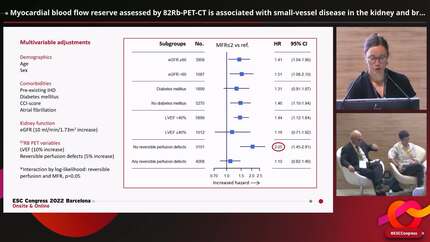
In crude analysis MBFR ≤2 was significantly associated with ME (p<0.0001, Fig. 1) as well as renal- and cerebral ME (both p<0.001). Similar results were found in subgroup analysis of patients with diabetes, normal kidney function (eGFR ≥60) or no perfusion defects, respectively (Fig. 1). After multivariate adjusting for demographics, IHD, cardiovascular risk factors, Charlson's Comorbidity index, atrial fibrillation and stratifying by chronic kidney disease stages, MBFR remained a significant predictor of ME (HR 1.43, 95% CI 1.15–1.78, p<0.001, fig. 2). In subgroup analysis including only patients with no reversible perfusion defects, MBFR ≤2 was associated with a HR of 2.04, 95% CI 1.43–2.91, p<0.0001 for ME.
This is the first larger cohort study relating CMD to microvascular outcome in the kidneys and brain. We conclude that CMD is an independent predictor of cerebral and renal ME. Data support the hypothesis that CMD is part of a systemic vascular disorder.
Type of funding sources: Public hospital(s). Main funding source(s): Research Committee, Bispebjerg & Frederiksberg University Hospital, scientific scholarship
Figure 1. Unadjusted Kaplan-Meier estimates
Figure 2. Adjusted Hazard Ratio (HR)
Contributors

S Hojstrup
Author
K Hansen
Author
U Talleruphuus
Author
L Marner
Author
S Galatius
Author
M Rauf
Author
L Bjerking
Author
L Jakobsen
Author
E Christiansen
Author
K Bouchelouche
Author
H Christensen
Author
E Prescott
Author
You may be interested in