Differences in microRNA expression in pericoronary tissue adjacent to atherosclerotic plaque and from lesion-free coronary artery
European Heart Journal


Abstract
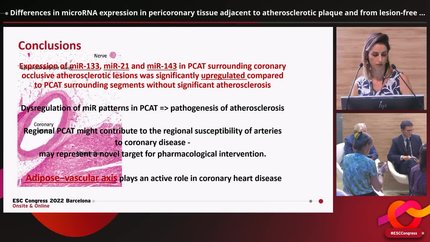
Pericoronary adipose tissue (PCAT) plays a key role in the pathogenesis of atherosclerosis. PCAT is a source of microRNAs (miRs) that acts as messengers for intercellular communication. In this study, we investigated whether the PCAT surrounding coronary occlusive atherosclerotic lesions shows specific miR expression patterns compared to PCAT surrounding plaque-free segments.
To evaluate the expression of miRs that are known to be implicated in the pathophysiology of atherosclerosis.
We included 49 patients (38 men, age 65±9 years) with 3-vessel coronary artery disease, who underwent elective coronary bypass surgery. The PCAT was harvested from two sites: adjacent to an occlusive atherosclerotic coronary lesion, and a plaque-free segment. miR-133a, miR-21, miR-26b, miR-9 and miR-143 levels in PCAT cells were quantified by real-time reverse transcription polymerase chain reaction.
miR-26b, miR-21 and miR-143 showed significantly greater expression in PCAT samples taken from around atheromatous plaque (154±295 versus 37±96, p=0.014, for miR-26b; 122±265 versus 29±79, p=0.014, for miR-21; and 181±356 versus 31±50, p=0.03, for miR-143) (Figure 1). In addition, the expression of miR-143, miR-26b and miR-21 in PCAT from atherosclerotic plaque showed robust positive correlations with body.mass index (r=0.451, p=0.001, r=0.41, p=0.03 and r=0.416, p=0.003 respectively),
Analysis of PCAT located in proximity to atherosclerotic plaque showed a different pattern of miR expression compared to PCAT in a plaque-free segment. Our findings open new perspectives for the role of PCAT in the pathophysiological mechanisms of atherosclerotic disease and should be further investigated.
Type of funding sources: None.
Figure 1
Contributors

M Marketou
Author
J Kontaraki
Author
P Kalogerakos
Author
A Plevritaki
Author
T Pateromichelakis
Author
S Kassotakis
Author
S Maragkoudakis
Author
E Kampanieris
Author
S Zervakis
Author
E Savva
Author
G Mpantouvakis
Author
G Lazopoulos
Author
G Kochiadakis
Author
You may be interested in