Efficacy of empagliflozin in patients with heart failure according to baseline KDIGO risk categories – findings from the EMPEROR-Pooled
European Heart Journal


Abstract
Chronic kidney disease (CKD) is common in patients with heart failure (HF) and is associated with an incrementally higher risk for mortality and morbidity. EMPEROR-Pooled studied 9,718 HF patients across two trials and showed that empagliflozin reduces the risk for HF hospitalization or cardiovascular (CV) death, slows the progression of estimated glomerular filtration rate (eGFR) decline, and improves health status in patients with HF and reduced ejection fraction (HFrEF) as well as preserved ejection fraction (HFpEF).
We explored the effect of empagliflozin on CV and kidney endpoints in patients across KDIGO (Kidney Disease Improving Global Outcomes) risk categories in EMPEROR-Pooled.
3,730 participants with left ventricular EF ≤40% (EMPEROR-Reduced) and 5,988 with left ventricular EF >40% (EMPEROR-Preserved) were categorized using baseline eGFR and UACR values into 4 categories according to KDIGO classification. The key outcomes were (1) a composite of CV death or hospitalization for HF, (2) first hospitalization for HF, (3) CV death and (4) eGFR slope change/year.
The proportion of participants in low-, moderate-, high-, and very high-risk KDIGO categories was 31.4%, 29.6%, 22.0%, 16.9% for empagliflozin and 32.5%, 28.4%, 21.8%, 17.2% for placebo, respectively. Patients on placebo in higher baseline KDIGO risk categories had a higher risk of CV death or hospitalization for HF (6.78, 11.30, 15.15, and 20.70 events per 100 patient-years for low-, moderate-, high-, and very high-risk patients, respectively) (Figure 1). Similar trends were seen for first HF hospitalization (4.46, 7.68, 11.14, and 15.98 per 100 patients-years at risk) and CV death (2.98, 5.31, 5.69, and 7.60 per 100 patients-years at risk). eGFR slope decreased less in higher baseline KDIGO risk categories (−3.13 in low-, −2.81 in moderate-, −2.17 in high- and −1.61 ml/min/1.73 m2 per year in very high-risk category) (Figure 2).
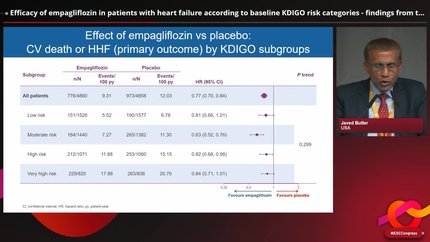
Empagliflozin reduced the risk of CV death or hospitalizations for HF similarly across KDIGO risk categories (hazard ratio [HR] 0.81; 95% confidence interval [CI] 0.66, 1.01 for low-, HR 0.63; 95% CI 0.52, 0.76 for moderate-, HR 0.82; 95% CI 0.68, 0.98 for high- and HR 0.84; 95% CI 0.71, 1.01 for very high-risk group; P trend=0.299). Similarly, empagliflozin reduced the risk of first HF hospitalization (P trend=0.186), CV death (P trend=0.663) or eGFR slope change (P trend=0.069) across the four groups.
Treatment with empagliflozin reduced the risk for CV death or HF hospitalization and slowed the rate of kidney function decline similarly in all KDIGO CKD risk categories.
Type of funding sources: Private company. Main funding source(s): Boehringer Ingelheim & Eli Lilly and Company Diabetes Alliance
Figure 1. Effects of empagliflozin versus placebo on outcomes in participant subgroups defined by baseline KDIGO risk categories in EMPEROR-Pooled.
Figure 2. Effects of empagliflozin versus placebo on mean slope of change in eGFR in participant subgroups defined by baseline KDIGO risk categories in EMPEROR-Pooled.
Contributors

J Butler
Author
You may be interested in