Association of beta blocker use with new-onset heart failure and mortality in atrial fibrillation without pre-existing heart failure: the Fushimi AF registry
European Heart Journal


Abstract
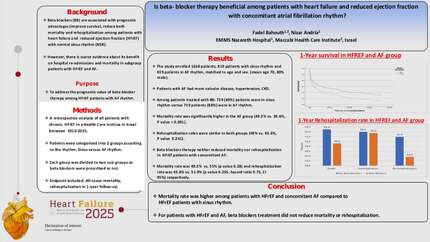
Heart failure (HF) is one of the major complications in atrial fibrillation (AF). We previously reported that not a few AF patients without pre-existing HF (defined as prior HF hospitalization, New York Heart Association functional class≥2, or left ventricular ejection fraction (LVEF)<40%) subsequently developed new-onset HF. Beta blockers are the established therapy for HF, but it remains unclear whether beta blockers prevent new-onset HF and improve outcomes in AF patients without preexisting HF.
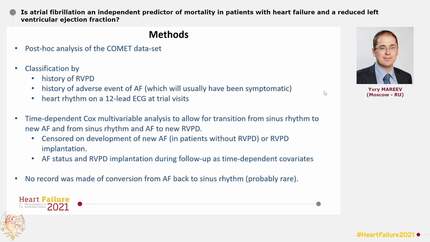
In the Fushimi AF registry, 778 of 3,262 patients without pre-existing HF were receiving beta blockers at baseline. We investigated the incidence of new-onset HF defined as cardiac death or HF hospitalization, and all-cause death in a propensity-matched cohort (N=1,198; mean age, 71 years; 39% female; mean LVEF, 66%). Additionally, annual follow-up prescription data before the onset of events were collected in 294 of patients with beta blockers and 395 of those without beta blockers. We also investigated the association of starting or stopping beta blockers with the incidence of new-onset HF and all-cause death.
During the median follow-up of 5.8 years, new-onset HF and all-cause death occurred in 77 (12.9%) and 118 (19.7%) of patients with beta blockers, and 70 (11.7%) and 131 (21.9%) of those without beta blockers, respectively. Incidence of new-onset HF was comparable between patients with and without beta blockers (Figure 1), and incidence of all-cause death was also comparable between the two groups (Figure 2). In exploratory subgroup analyses, there was no interaction in the association of beta blockers with the incidence of events, except for pulse rate for new-onset HF and left atrial size for all-cause death. Hazard ratio of beta blockers for new-onset HF tended to be lower in patients with higher pulse rates (>84 bpm) (Figure 1), and that for all-cause death was lower in those without left atrial enlargement (Figure 2). Of patients with follow-up prescription data, beta blockers were stopped in 55 (18.7%) and started in 97 (24.6%) patients, respectively. Patients with starting beta blockers had higher pulse rate (78.5±17.3 vs 74.9±13.9 bpm; p=0.03) and more symptomatic AF (58.8% vs 46.0%; p=0.03) compared to those without starting beta blockers, while there was no difference in baseline characteristics between those with and without stopping beta blockers. During the follow-up, the incidences of new-onset HF and all-cause death were also comparable between the patients with and without stopping beta blockers and those with and without starting beta blockers.
Beta blockers were not associated with the incidence of new-onset HF and all-cause death in AF patients without pre-existing HF. However, the exploratory subgroup analyses suggested the existence of subjects who may benefit from beta blockers.
Type of funding sources: Private company. Main funding source(s): Boehringer Ingelheim, Bayer Healthcare, Pfizer, Bristol-Myers Squibb, Astellas Pharma, AstraZeneca, Daiichi Sankyo, Novartis Pharma, MSD, Sanofi-Aventis, and Takeda Pharmaceutical.
Contributors

M Iguchi
Author
N Masunaga
Author
M Ishii
Author
A Fujino
Author
Y Ide
Author
Y Hamatani
Author
T Yoshizawa
Author
K Doi
Author
S Ikeda
Author
M Esato
Author
H Wada
Author
K Hasegawa
Author
H Ogawa
Author
M Abe
Author
M Akao
Author
You may be interested in