Comparison of COVID-19 clinical course between LVAD recipients implanted before and during COVID-19 pandemic
European Heart Journal


Abstract
Left ventricular assist devices (LVAD) recipients are particularly vulnerable to cardiac- and non-cardiac related complications. COVID-19 pandemic disorganized virtually all aspects of life, affecting the health care systems and impeded its availability. Yet, patients with advanced heart failure (HF) implanted with LVADs had to cope with restricted access to specialized HF centers and as well as COVID-19 infection. The course of COVID-19 in LVAD population is largely unknown.
We sought to verify whether there are any differences in COVID-19 course in LVAD recipients implanted before and during COVID-19 pandemic.
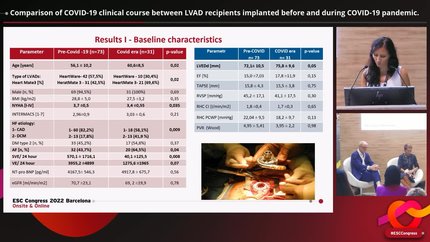
Between October 2015 and December 2019 (pre-COVID-19 era=group 1) 71 patients and since January 2020 to December 2021 (COVID-19 era=group 2) 31 patients were implanted with LVAD in a tertiary center in Poland. Of note, at the beginning of COVID-19 era (since 1st/Jan/2020) there were alive 39 (55%) previously implanted LVAD patients. The censor date for this analysis was 31st December 2021.
COVID-19 occurred in a similar percentage in both groups (group 1 – 39% vs. group 2 – 32%; p=0,4; however, more patients from group 1 required hospitalization [12 (80%) vs. 6 (60%); p<0.05] (Table 1). Blood oxygen saturation (SpO2) and mean arterial pressure (MAP) were lower in the group 1 in comparison to group 2 (86.5 vs. 95% and 69 vs. 79 mmHg; respectively, both p<0.05); however, respiratory and heart rates were similar. There were significant differences of white blood count (WBC) and their subpopulations between both groups. As for inflammatory markers, both procalcytonine and interleukin 6 (IL-6) were significantly higher in the group 1 (3.6 vs. 06 ng/ml and 112.5 vs. 87 pg/ml; respectively; both p<0.05); however CRP levels were similar. All patients from group 1 required oxygen therapy [12 (100%) vs. 4 (66.7%); p<0.05]. Intravenous inotropes were also more commonly used in patients from group 1 [10 (83%) vs. 2 (33%); p<0.05]; however, other standard COIVD-19 therapies were similarly utilized in both groups. Two (5.1%) patients from group 1 and 1 (3.2%) patient from group 2 (p=0.29) died due to COVID-19. There were also no differences between non-COVID-19 related deaths between the groups (p=0,63). The vaccination rate against COVID-19 was similar in both groups – 65.7%.
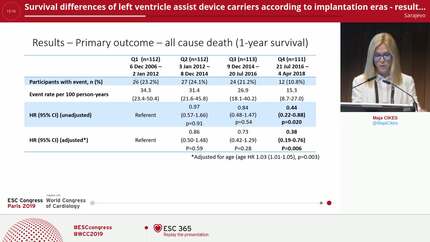
COVID-19 infections were common in LVAD recipients. Although clinical and laboratory profiles of LVAD recipients implanted before COVID-19 pandemic were worse in comparison to those who were implanted more recently, the actual survival rates were found to be similar. Surprisingly, only two-thirds of LVAD patients decided to undertake vaccine against COVID-19. These initial and single-center observations need to be interpreted with caution until more thorough analyses on more LVAD patients will be released.
Type of funding sources: None.
Contributors

S Wisniowska-Smialek
Author
P Rubis
Author
I Gorkiewicz-Kot
Author
G Wasilewski
Author
M Kaleta
Author
D Sobczyk
Author
E Dziewiecka
Author
B Kapelak
Author
K Wierzbicki
Author
You may be interested in