Response and long-term outcomes with resynchronization therapy: the role of heart failure etiology
European Heart Journal


Abstract
Resynchronization therapy (CRT) reduces mortality across all etiologies of heart failure (HF). Reverse left ventricular (LV) remodelling has been reported to occur more often in non-ischemic patients.
To compare response and outcomes after CRT in non-ischemic (NIHF) and ischemic (IHF) HF patients.
Single-center retrospective study of consecutive patients submitted to CRT implantation (2007–2018). Major adverse cardiac events (MACE) included HF hospitalization or all-cause mortality (ACM). Clinical response was defined as New York Heart Association (NYHA) class improvement without MACE in the 1st year of follow-up (FU). Echocardiographic (echo) response implied left ventricle end-systolic volume reduction of >15% at 1-year. LV ejection fraction [LVEF] ≥50% during 1st year of FU defined superresponse. Survival analysis with Kaplan-Meier method and Log-rank test was performed to compare outcomes. Multivariate analysis was performed to assess if HF etiology predicted response to CRT.
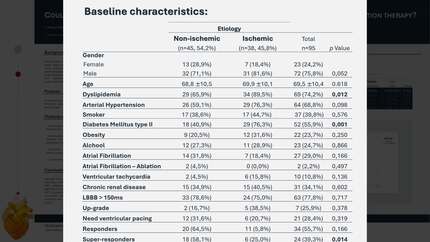
295 patients (mean age 67±11 years, 91.5% left bundle branch block, baseline QRS 171±22 ms) were included. Patients in NIHF group (n=208, 72.5%) were more often female (35.6% vs 15.6%, p<0.001), tended to be younger (67 vs 70 years, p=0.05), had more valve disease (36.7% vs 23.6%, p=0.037) and kidney disease (32.9% vs 18.5%, p=0.015). In NIHF patients, right ventricular dysfunction (tricuspid annular plane systolic excursion <17 mm) was less common (25.6% vs 47.1%, p=0.039). Addition of defibrillator was identical (53.8% vs 55.7%, p=0.882).
NYHA class improvement (79.4% vs 78.4%, p=0.987) and echo response (71.2% vs 74.4%, p=0.860) were similar. NIHF patients were more often superresponders (25.7% vs 9.5%, p=0.006), with greater improvement in LVEF (Δ 11.6% vs 7.6%, p<0.001). Clinical response was more frequent in NIHF patients (66.3% vs 50.6%, p=0.023).
After multivariate analysis, HF etiology was not predictive of clinical (p=0.960) or echo response (p=0.075). During a mean FU of 3.8 years, occurrence of MACE (Log rank test, p<0.001) and ACM (Log rank test, p<0.001) were lower in NIHF [Figure 1]. Ventricular arrythmias (6.4% vs 7.5%, p=0.993) or appropriate defibrillator therapies (5.3% vs 7.5%, p=0.743) did not differ.
In this cohort, consisting mostly of patients with LBBB and QRS ≥150 ms, HF etiology did not predict clinical or echo response to CRT. Still, NIHF patients showed a greater extent of LV remodelling. Lower MACE and ACM rates were also observed in non-ischemic patients.
Type of funding sources: None.
Figure 1
Contributors

M Brandao
Author
J Goncalves Almeida
Author
P Fonseca
Author
E Santos
Author
F Rosas
Author
A J Tavares
Author
J Nogueira Ribeiro
Author
M Oliveira
Author
H Goncalves
Author
J Primo
Author
R Fontes-Carvalho
Author
You may be interested in