The effect of kidney dysfunction on introducing guideline-derived medical therapy and on mortality among hospitalized patients with heart failure with reduced ejection fraction
European Heart Journal


Abstract
Chronic kidney disease (CKD) is one of the main limiting factors of introducing and uptitrating guideline-derived medical therapy (GDMT) among patients with heart failure with reduced ejection fraction (HFrEF). Only few studies evaluated the success of implementation of pharmacotherapy in HFrEF and its effect on prognosis across the whole spectrum of CKD stages.
To analyze the implementation differences of mortality reducing triple therapy (ACEi/ARB/ARNI + BB + MRA) by severity of CKD among hospitalized HFrEF patients. Furthermore, we evaluated the association between mortality and CKD stages.
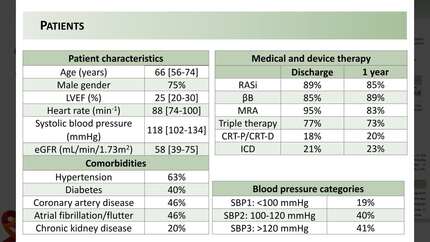
257 consecutive, hospitalized HFrEF patients' data were analyzed retrospectively, who had been hospitalized at the Heart Failure Unit of a tertiary cardiological centre in 2019–2021 (male: 74%, age: 65 [56–73] years, ischemic: 45%, diabetes: 40%, hypertension 58%, atrial fibrillation 46%, LVEF: 25 [20–30] %, NT-proBNP at admission: 6086 [2757–11994] pg/ml). Median eGFR was 58 [39–74] ml/min/1.73 m2, 53% of patients had eGFR <60 ml/min/1.73 m2 (CKD stage: G1 – eGFR >90 ml/min/1.73 m2: 15%, G2 – eGFR = 60–90 ml/min/1.73 m2: 32%, G3A – eGFR = 45–59 ml/min/1.73 m2: 20%, G3B – eGFR = 30–44 ml/min/1.73 m2: 21%, G4 – eGFR = 15–29 ml/min/1.73 m2: 9%, G5 – eGFR <15 ml/min/1.73 m2: 3%). 1% of patients was on dialysis.
The success of implementing triple-therapy depending on CKD stages was investigated with Chi-square test, while mortality differences were analyzed with Kaplan-Meier method.
The severity of CKD led to significantly (p<0.0001) lower implementation rate of triple-therapy (CKD stage G1–G2–G3A–G3B–G4–G5: 92 vs. 87 vs. 81 vs. 74 vs. 29 vs. 43%). However, only the ratio of RASi use showed significant difference (p<0.0001) among CKD subgroups (stage G1–G2–G3A–G3B–G4–G5: 100 vs. 100 vs. 92 vs. 87 vs. 42 vs. 43%), while BB (CKD stage G1–G2–G3A–G3B–G4–G5: 92 vs. 88 vs. 88 vs. 81 vs. 71 vs. 71%; p=0.162) and MRA (CKD stage G1–G2–G3A–G3B–G4–G5: 97 vs. 98 vs. 96 vs. 93 vs. 83 vs. 100%; p=0.0899) implementation was independent of renal function. All-cause 6-month mortality was 14% in the whole population. 6-months mortality rates proved to be higher (p=0.0083) in patients with more severe CKD (stage G1–G2–G3A–G3B–G4–G5: 8 vs. 11 vs. 8 vs. 20 vs. 35 vs. 29%).
Patients with advanced HFrEF and concomitant CKD are not equally treated with GDMT, even though kidney dysfunction is not an absolute contraindication of cornerstone HFrEF therapies. HFrEF patients with more severe CKD have poorer prognosis, thus implementation of mortality- and morbidity reducing drug therapy according to the guidelines is essential.
Type of funding sources: None.
Contributors

B Muk
Author
F Banfi-Bacsardi
Author
Z S Majoros
Author
D Vagany
Author
T Borsanyi
Author
S Lee
Author
D Pilecky
Author
G Z Duray
Author
R G Kiss
Author
N Nyolczas
Author
You may be interested in