Association between use of renin-angiotensin system inhibitors/angiotensin receptor neprilysin inhibitors and beta-blockers and outcome in real-world heart failure and mildly reduced ejection fraction
European Heart Journal


Abstract
In heart failure with mildly reduced ejection fraction (HFmrEF) European guidelines recommend the use of antineurohormonal therapies with a low level of evidence (IIb C) based on data from subgroup and post-hoc analyses of randomized clinical trials (RCTs). Data from large and unselected real-world HFmrEF populations are lacking.
To assess the association between renin-angiotensin system inhibitors/angiotensin receptor neprilysin inhibitors (RASI/ARNI) and beta-blockers and outcomes in HFmrEF.
Data from patients with HFmrEF (EF: 40–49%) from the Swedish HF Registry during 2000–2018 were considered. The association between each of RASI/ARNI and beta-blockers treatment and cardiovascular (CV)mortality/heart failure hospitalization (HFH) and all-cause mortality was assessed by Cox proportional hazard models in a 1:1 propensity score-matched cohort. Since propensity score (PS) matching might lead to a selection of the study population and reduction of the sample size, as consistency analysis Cox proportional hazard models were also fitted in the overall cohort adjusting rather than matching for PS.
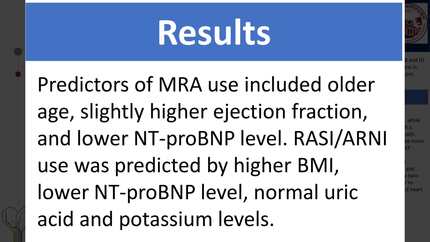
Of 12421 patients with HFmrEF (mean age 74±12 years, 64% males), 10419 (84%) received RASI/ARNI, 10941 (88%) received beta-blockers. Patients treated with both RASI/ARNI and beta-blockers were 9332 (75%), 2696 (22%) patients received one drug (9% RASI/ARNI, 13% beta-blockers) and 393 (3%) none. Main predictors of treatments use were younger age, female sex (only for beta-blockers), outpatient setting, referral to specialty care and nurse-led HF clinic. Lower NT-proBNP levels were associated with more use of RASI/ARNI but less use of beta-blockers. Better renal function was predictive of RASI/ARNI use. Comorbidities were associated with less use of treatments, in particular atrial fibrillation for RASI/ARNI, and COPD for RASI/ARNI and beta-blockers. In the matched cohorts including 3854 for RASI/ARNI analyses and 2940 patients for beta-blockers, RASI/ARNI (HR=0.90, 95% CI: 0.83–0.97) and beta-blocker (HR=0.82, 95% CI: 0.75–0.91) use were associated with a statistically significant lower risk of CV mortality/HF hospitalization (Figure 1) and of all-cause mortality (HR=0.72, 95% CI: 0.67–0.78 and HR=0.77, 95% CI: 0.70–0.85, respectively). Consistency analysis confirmed results.
RASI/ARNI and beta-blockers were largely used in this large real-world cohort of patients with HFmrEF to treat comorbidities. Their use was associated with lower risk of mortality/morbidity and the magnitude of the associations was somehow similar to what observed in subgroup/post-hoc analyses of RCTs. Our findings call for a fast implementation of guidelines recommendations on HFmrEF treatment.
Type of funding sources: None.
Figure 1. Survival curves
Contributors

D Stolfo
Author
F Lindberg
Author
L Lund
Author
G Sinagra
Author
U Dahlstrom
Author
G Rosano
Author
G Savarese
Author