Long-term cardiac adverse effects after modern Hodgkins lymphoma treatment
European Heart Journal


Abstract
Hodgkin's lymphoma (HL) frequently affects both children and young adults. Traditional treatment of HL is effective but associated with a life-time prevalence of cardiac disease exceeding 50%. Treatment protocols were modified in 1997 to reduce cardiotoxicity, primarily by reducing both radiation fields and doses.
To assess the long-term impact of the modified treatment protocols on left ventricular cardiac function.
HL survivors (n=244) treated with anthracycline-based chemotherapy using modified treatment protocols in 3 centres in Norway between 1997 and 2007 were included in this cross-sectional study. Of these, 130 (53%) also received mediastinal radiotherapy. They were compared to controls recruited from the general population (n=58) matched for age, sex, and risk-factors. Echocardiography was performed in all subjects.
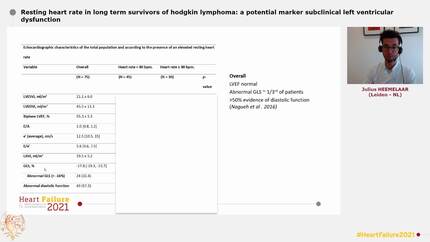
The participants were on average 46±9 years old and had received treatment on average 17±3 years before examination. Echocardiographic parameters are shown in the table. Reduced left ventricular (LV) ejection fraction (EF) (<52%) was found in 19 HL-survivors and three controls (13% vs. 6%, p=0.24). Reduced LV global longitudinal strain (GLS) (> −18.0%) was found in 41 HL survivors and three controls (25% vs. 6%, p<0.05). There was no difference in prevalence of reduced GLS between HL survivors who received mediastinal radiotherapy and those who did not (26% vs. 24%, p=0.70).
While a minority of HL survivors did have a slight reduction in longitudinal deformation, the effect was small and importantly, we found no difference in EF between HL survivors treated with modified protocols and controls. Mediastinal radiotherapy did not seem to increase the prevalence of reduced cardiac function in HL survivors.
Type of funding sources: Public hospital(s). Main funding source(s): South-Eastern Norway Regional Health Authority
Contributors

A W Bjerring
Author
K H B Smeland
Author
I Baerug
Author
K H Haugaa
Author
C E Kiserud
Author
T Edvardsen
Author
S I Sarvari
Author
You may be interested in