Right atrial function in HFpEF in sinus rhythm vs. atrial fibrillation
European Heart Journal


Abstract
We sought to study the prognostic impact of right atrial (RA) size and function in patients with heart failure with preserved ejection fraction (HFpEF) in sinus rhythm (SR) vs. atrial fibrillation (AF).
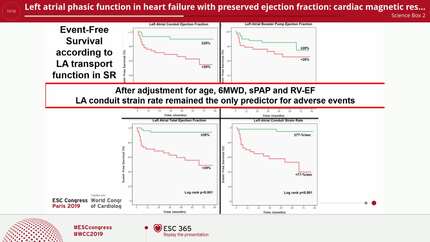
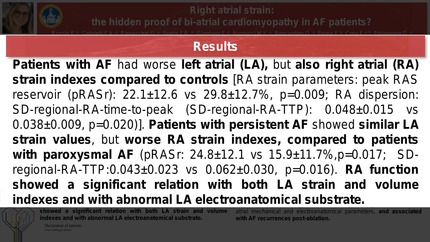
Consecutive HFpEF patients were enrolled and indexed RA volumes and emptying fractions (RA-EF) were assessed by cardiac magnetic resonance imaging (CMR). For patients in SR during CMR feature tracking of the RA wall was performed (Figure 1). In addition, all patients underwent right and left heart catheterization, 6 min walk test, and N-terminal prohormone of brain natriuretic peptide (NT-proBNP) evaluation. We prospectively followed patients and used Cox regression models to determine the association of RA size and function with a composite endpoint of heart failure hospitalization and cardiovascular death. A total of 188 patients (71% female patients, 70±8 years old) were included of whom 96 (51%) were in SR. Eighty-five patients reached the combined endpoint during a follow-up of 72 (33–101) months. After multivariate cox regression analysis adjusted for age, NT-proBNP level, right ventricular ejection fraction and HF functional class, impaired RA strain (Figure 1A) (HR 0.959; 95% CI [0.924–0.996], P=0.024), RA conduit strain (Figure 1A) (HR 0.944; 95% CI [0.898–0.993], P=0.027) and RA conduit strain rate (Figure 1B) (HR 0.990; 95% CI [0.883–0.998], P=0.013) were significantly associated with adverse outcome for patients in SR (Table 1). In persistent AF, no RA imaging parameter was related to outcome after multivariate regression analysis.
In HFpEF patients in SR, CMR parameters of impaired RA conduit function show the best association with adverse cardiovascular outcome. In persistent AF, RA parameters lose their prognostic ability.
Type of funding sources: None.
Figure 1
Table 1
Contributors

R Schoenbauer
Author
F Hana
Author
F Duca
Author
M Koschutnik
Author
C Dona
Author
C Nitsche
Author
M Sponder
Author
M Lenz
Author
C Loewe
Author
D Beitzke
Author
C Hengstenberg
Author
J Mascherbauer
Author
A A Kammerlander
Author
You may be interested in