Acute hemodynamic effects of biventricular pacing studied during cardiovascular magnetic resonance imaging: the PICARIA Trial
European Heart Journal


Abstract
Cardiac resynchronization therapy (CRT) is hampered by a relative high rate of non-response whereby device optimization could aid in improving benefit from CRT. Nonetheless, a non-invasive and reproducible clinical tool for device optimization is currently lacking. Recently introduced cardiovascular magnetic resonance (CMR) compatible CRT devices may allow for patient follow-up and device optimization as biventricular (BIV) pacing can be performed during the CMR exam. However, to date, CMR evaluation of acute pump function changes during CRT is limited.
To assess the effects of BIV-pacing on change in left ventricular (LV) function and contraction patterns using CMR.
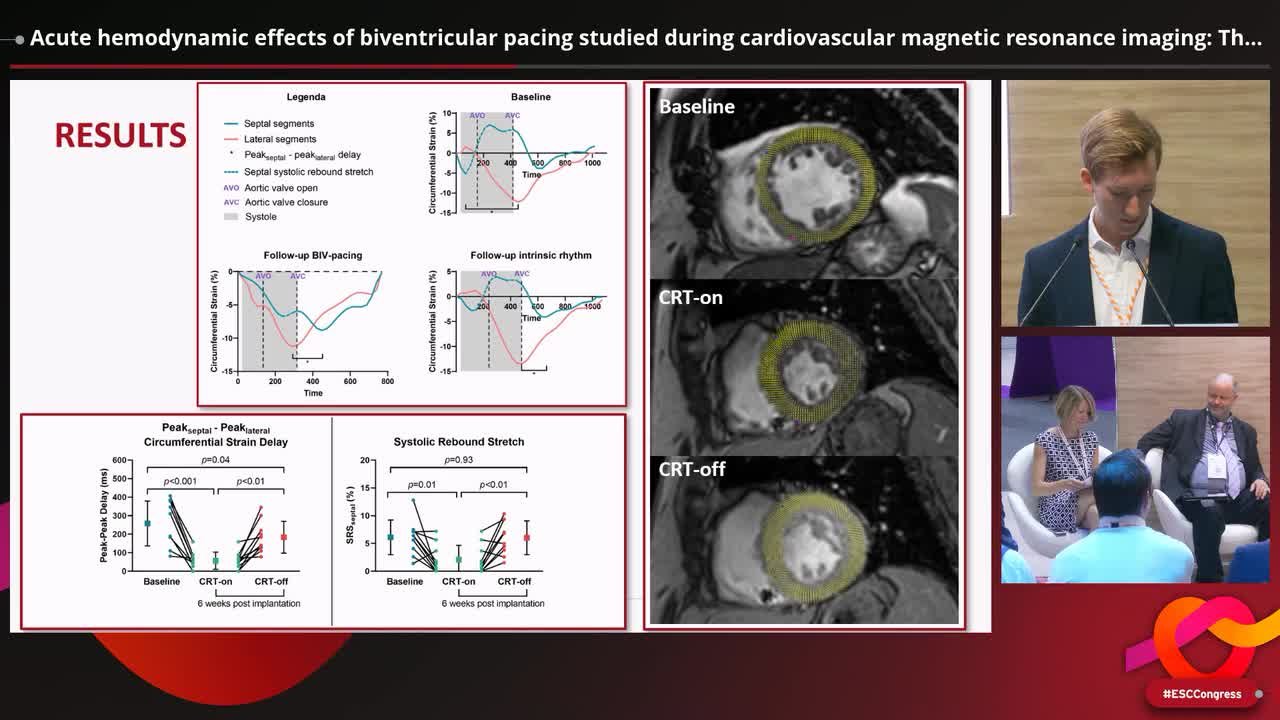
Ten patients were included in this prospective pilot study. All patients underwent CMR imaging (1.5T system) prior to device implantation (baseline), and 6 weeks after device implantation (CRT-on and CRT-off). LV end systolic volume (ESV), end diastolic volume (EDV), ejection fraction (LVEF), and measures of LV dyssynchrony and dyscoordination (septal systolic rebound stretch (SRSseptal)) were assessed on cine images.
LV function and contraction patterns before and after device implantation are compared and displayed in the figure. LV ESV and EDV decreased in all patients during BIV-pacing as compared to intrinsic rhythm (CRT-off) (ESV; 161.4±36.3ml vs. 194.9±37.1ml, p<0.01 and EDV; 236.2±31.8ml vs. 268.1±42.3ml, p<0.01). A significant improvement in LVEF was observed during BIV-pacing (32.2±8.7% vs. 27.4±5.9%, p<0.01). Both, regional dyssynchrony and regional dyscoordination significantly improved during CRT-on compared to CRT-off (peakseptal-peaklateral; 57±46ms vs. 183±86ms, p<0.01 and SRSseptal; 2.1±2.6% vs. 6.0±3.0%, p<0.01).
Post-CRT implantation CMR assessing acute pump function changes to different CRT pacing settings is feasible and provides important insights in the effects of BIV-pacing on cardiac function and contraction patterns. LV assessment using CMR, potentially in combination with non-invasive pressure measurements, may constitute a future CRT optimization strategy.
Type of funding sources: Private grant(s) and/or Sponsorship. Main funding source(s): Biotronik (Berlin, Germany)
Figure 1
Contributors

L H G Hopman
Author
A Zweerink
Author
A C J Van Der Lingen
Author
M J Mulder
Author
L F H Robbers
Author
V P Van Halm
Author
A C Van Rossum
Author
M J W Gotte
Author
C P Allaart
Author
You may be interested in