Utilization and in-hospital complications associated with implantation of dual versus single chamber implantable cardioverter defibrillator for primary prevention of sudden cardiac death
European Heart Journal


Abstract
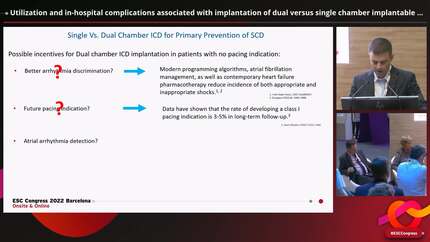
Multiple studies showed no clinical benefit in implantation of a dual compared to a single chamber implantable cardioverter defibrillator (dICD vs. sICD) for primary prevention of sudden cardiac death (SCD), in patients with no pacing indication. We aimed to investigate the extent of utilization and complications in sICD vs. dICD implantations in the US, using the National In-Patient Sample (NIS) database.
Using the NIS database, we identified patients who underwent an elective ICD implantation in the US between 2015 (last quarter)-2019. Patients who had concurrent conduction disorders or indication for atrial pacing were excluded. Baseline demographics, clinical characteristics, cardiomyopathy etiologies as well as outcomes including in-hospital complications, length of stay and mortality were collected. Multivariable logistic regression models were used to identify predictors of complications.
An estimated total of 15940 patients, who underwent elective ICD implantation for primary prevention of SCD were identified, 8860 (55.6%) of them received a dICD. Forty percent of patients had ischemic cardiomyopathy. The mean age was 64 years and 66% were males. The complication rates documented in the dICD and sICD groups were 13% and 11%, respectively (p<0.001),driven by increased rate of pneumothorax (4.8% vs 3.2%, p<0.001) and lead dislodgement (3.6% vs 2.3%, p<0.001, Table 1). Multivariate analysis confirmed adding an atrial lead as an independent risk factor for “any complication” during ICD implantation [OR 1.13 (1.02–1.25), p=0.022] as well as for pneumo/hemothorax [OR 1.21 (1.03–1.44), p=0.025] and lead dislodgement [OR 1.41 (1.16–1.72), p<0.001].
Despite significant evidence for lack of clinical benefit in adding an atrial lead to a primary prevention ICD implantation, significant proportion of the patients in the US are implanted with a dICD. We show increased risk for complications for dICD compared with sICD implantation in the US in recent years, driven by higher incidence of pneumo/hemothorax and lead dislodgement.
Type of funding sources: None.
Contributors

G Margolis
Author
G Elbaz Greener
Author
M Kazatzker
Author
S Meisel
Author
M Kleiner Shochat
Author
E K Heist
Author
J Ruskin
Author
O Amir
Author
A Roguin
Author
G Rozen
Author
You may be interested in