Long-term toxicity of radiosurgery for ablation of ventricular tachycardia
European Heart Journal


Abstract
There is a rising interest in using radiosurgery to modify arrhythmogenic substrate in patients with recurrent VT. However, data on the safety are still inadequate.
This is update of toxicity evaluation based on the compilation from our case series, NIRA-VT and STAR-VT.
Between 2014 and March 2021, 36 patients (33 male, 3 females; mean age 66±10 years) with structural heart disease (ischemic cardiopathy, dilated cardiopathy or fibroma associated scar) from two electrophysiology centers in the Czech Republic (Trinec, Prague) underwent radiosurgery for recurrent VT.
Radiosurgery was performed after at least one failed catheter ablation for VT. The critical part of the VT substrate was identified by electroanatomic mapping using a combination of voltage mapping, pace mapping, and activation mapping; and it was marked on a contrast-enhanced computer tomography study as a CTV. In NIRA-VT trial, CTV included scar based on PET/CT evaluation. Radiosurgery system with real-time motion tracking using the tip of the electrode of an indwelling defibrillator as a fiducial marker was used. A total radiation dose of 25 Gy was delivered to the ablation target in a single session during free breathing. Radiation-induced toxicity was evaluated according to the Common Terminology Criteria for Adverse Events (CTCAE) version 4.0. Only patients with follow up longer than 6 months were included in long term radiation related side effects evaluation.
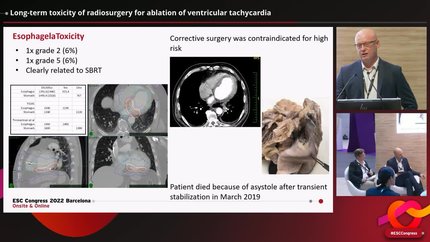
The mean CTV and PTV were 26±11 ml and 41±22 ml respectively. No patient exhibited acute (up to 3 months) elevation of troponin, pericardial effusion, or a decrease in left ventricular ejection fraction from baseline. Four patients developed acute mild nausea, which waned after antiemetic drugs. Long-term radiation related side effects were evaluated in 19 patients. Two patients (11%) presented radiological signs of lung fibrosis in small area in close distance from PTV. There was no significant decrease in left ventricular ejection fraction during follow up. Six patients (33%) gradually developed significant progression of known mitral regurgitation after SBRT, two (11%) of them had to undergo mitral valve replacement (grade 4 toxicity). Two cases of esophagitis (12%) were seen with one radiation toxicity related death (grade 5 toxicity) due to the unresectable esophagi-pericardial fistula (6%).
Our data indicate the feasibility of radiosurgery, majority of patients presented no/mild radiation related toxicity and decrease of VT burden. However, we have seen three cases of grade 4,5 toxicity. To further investigate long-term safety and efficacy of radiosuergery for VT, enrolling into a randomized prospective study is in progress.
Type of funding sources: Public grant(s) – EU funding. Main funding source(s): European Union's Horizon 2020
Radiation plan leading to fistulation
Post-mortem picture of fistulation
Contributors

J Cvek
Author
P Peichel
Author
L Knybel
Author
O Jiravsky
Author
M Sramko
Author
J Hecko
Author
R Neuwirth
Author
J Plasek
Author
J Kautzner
Author
You may be interested in