Cardiac radioablation does not worsen cardiac function: preliminary safety results of the prospective STARNL-1 trial
European Heart Journal


Abstract
Cardiac radioablation for ventricular tachycardia (VT) appears to be highly effective and safe in patients with recurrent VT despite anti-arrhythmic therapy and catheter ablation(s), although global experience is currently very limited. Detailed echocardiographic strain analysis could provide important insights in (subclinical) functional safety. Importantly, current stereotactic cardiac radioablation techniques includes irradiation of the VT substrate but, inherently, also includes irradiation of the VT border zone and some healthy cardiac tissue. The latter particularly may result in detoriation of cardiac function after cardiac radioablation.
To evaluate functional echocardiographic safety of cardiac radioablation.
The STARNL-1 trial is a prospective, monocenter, single-arm, pre-post intervention study. Six patients with recurrent VT despite high dose anti-arrhythmic drugs, after (single or multiple) conventional catheter ablation and deemed unsuited for repeat catheter ablation, were treated with a single fraction 25 Gy radiotherapy dose. Per protocol, patients underwent echocardiograms at baseline, 24 hours after treatment, and 3 months after treatment. Echocardiograms were analysed using 2D-speckle tracking. Mean radiotherapy dose per segment was calculated according to the AHA 17-segment model. Echocardiographic parameters were compared between baseline, 24 hours and 3 months, and correlated to radiotherapy dose.
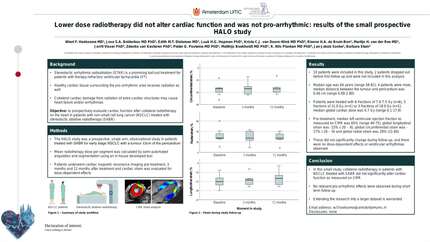
Patients were all male (age 55–83 years), all suffered from ischaemic cardiomyopathy, and all completed 3 month follow-up. At baseline, median left ventricle ejection fraction (LVEF) was 38% [30; 47] and median global longitudinal strain (GLS) −8% [−12; −5]. Interestingly, LVEF significantly improved 24 hours after treatment (42% [36; 49], p=0.046) but GLS did not change (−7% [−12; −5], p=0.833). At 3 months, both LVEF and GLS were unchanged compared to baseline (LVEF 39% [33; 49%], p=0.463; GLS −6% [−12; −5], p=0.893). The difference in longitudinal strain per segment before and after treatment did not correlate with the mean radiotherapy dose per segment, both 24 hours after treatment (Pearson coefficient −0.082, p=0.410) and 3 months after treatment (Pearson coefficient −0.005, p=0.957). In Figure 1 an illustrative case is presented.
Cardiac radioablation for VT does not worsen (subclinical) cardiac function within the first 3 months after treatment.
Type of funding sources: Foundation. Main funding source(s): Dutch Heart Foundation
Strain change and radiotherapy heat maps
Contributors

W Hoeksema
Author
M H Van Der Ree
Author
H A C M De Bruin-Bon
Author
E M T Dieleman
Author
J Visser
Author
R N Planken
Author
S M Boekholdt
Author
M A J De Jong
Author
M J B Kemme
Author
J C Balt
Author
B V Balgobind
Author
P G Postema
Author
You may be interested in