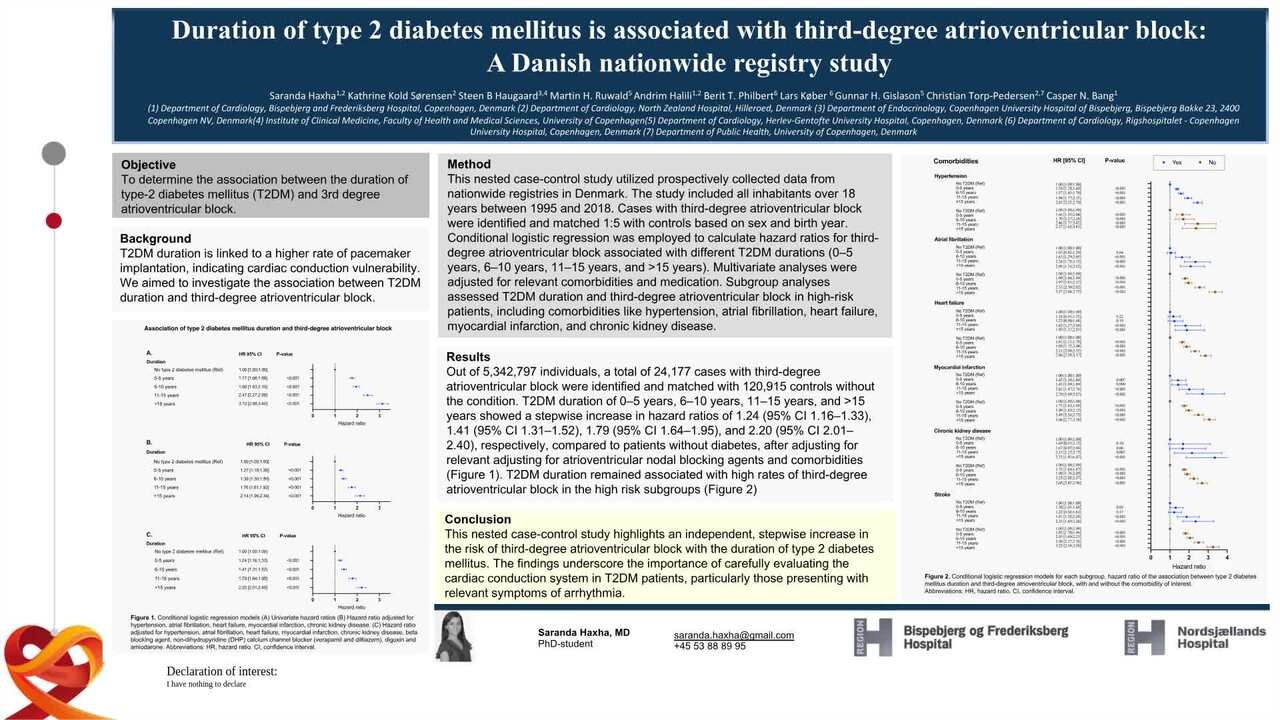
Type 2 diabetes is associated with higher risk of 3rd degree atrioventricular block: a Danish nationwide registry study
European Heart Journal


Abstract
Type 2 diabetes (T2DM) is suggested to affect the function of the cardiomyocytes and electrical pathways which could cause conduction abnormalities and cardiac arrhythmias, such as 3rd degree atrioventricular block. The association of T2DM and 3rd degree atrioventricular block has never been confirmed in large nationwide studies.
To determine the association between T2DM and 3rd degree atrioventricular block.
This nationwide nested case-control study design included patients older than 18 years, diagnosed with 3rd degree atrioventricular block between 1st of July 1995 and 31st of December 2018. Five controls from the risk set of each case of 3rd degree atrioventricular block were matched on age and sex to fit a Cox regression model with time-dependent exposure (T2DM) and time-dependent covariates and baseline hazard function stratified for age and sex. Subgroup analysis was conducted with Cox models for each subgroup.
We identified 31.177 cases with 3rd degree atrioventricular block that were matched with 155.885 controls. The mean age was 78 years and 60% were males. Cases had higher prevalence of T2DM (20% vs 7.8%), hypertension (70% vs 43%) myocardial infarction (16% vs 6.6%), and heart failure (21% vs 5.9%) compared to the control group. In a Cox analysis T2DM was significantly associated with a higher rate of 3rd degree atrioventricular block [HR 2.61 (95% CI: 2.54–2.71)]. The association remained in several subgroup analyses of diseases suspected to be associated with 3rd degree atrioventricular block. There was a significant interaction with sex and age groups and comorbidities of interest including hypertension, atrial fibrillation, heart failure and myocardial infarction (Figure 1).
T2DM is associated with a higher rate of 3rd degree atrioventricular block. The findings were consistent across subgroups.
Type of funding sources: Private grant(s) and/or Sponsorship. Main funding source(s): This work was funded by the independent research foundation Skibsreder Per Henrik, R. og Hustrus Fond
Figure 1. Subgroup analysis
Contributors

S Haxha
Author
A Halili
Author
M Malmborg
Author
U Pedersen-Bjergaard
Author
B T Philbert
Author
T B Lindhardt
Author
S Hoejberg
Author
A M Schjerning
Author
M H Ruwald
Author
G H Gislason
Author
C Torp-Pedersen
Author
C N Bang
Author
You may be interested in