Bleeding risk prediction in a large cohort of patients with atrial fibrillation and cancer: a nationwide cohort study
European Heart Journal


Abstract
The association between cancer types and specific bleeding events in atrial fibrillation (AF) patients has been scarcely investigated. Also, the performance of bleeding risk scores in this high-risk subgroup of patients is unclear.
We investigated the rate of intracranial haemorrhage (ICH), major (MB) and gastrointestinal bleeding (GB) according to cancer types in AF patients. We also tested the predictive value of HAS-BLED, ATRIA and ORBIT bleeding risk scores.
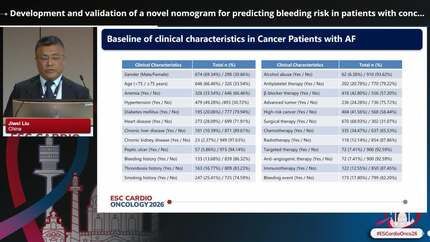
Observational retrospective cohort study including 399,344 AF patients with cancer (mean age 77.9±10.2 years; 63.2% men). MB was defined according to Bleeding Academic Research Consortium (BARC) definitions.
The highest ICH rates were found in leukaemia (1.89%/year), myeloma (1.52%/year), lymphoma and liver (1.45%/year) and pancreas cancer (1.41%/year). GBs were highest in liver (7.54%/year), pancreas (7.42%/year) and gastric (5.51%/year). Receiver operating characteristic (ROC) analysis showed that an ORBIT score ≥4 had the highest predictivity for MBs (AUC 0.805) followed by HAS-BLED and ATRIA (AUC 0.716 and 0.700, respectively). HAS-BLED and ORBIT performed best for ICH (AUC 0.744 and 0.742, respectively), better than ATRIA (AUC 0.635). For GB, ORBIT ≥4 had the highest predictivity (AUC 0.756), followed by the HAS-BLED (AUC 0.702) and ATRIA (AUC 0.662).
Some cancer types carry a greater bleeding risk in AF patients. The identification and management of modifiable bleeding risk factors is crucial in these patients, as well as to flag up high bleeding risk patients for early review and follow-up
Some cancer types carry a greater bleeding risk in AF patients. The identification and management of modifiable bleeding risk factors is crucial in these patients, as well as to flag up high bleeding risk patients for early review and follow-up.
Type of funding sources: None.

You may be interested in