Comparison of embolism and bleeding risk profile in patients with atrial fibrillation and chronic kidney disease
European Heart Journal


Abstract
Clinical decision-making on anticoagulation in chronic kidney disease (CKD) patients with atrial fibrillation (AF) is challenging. Current strategies are based on small observational studies with conflicting results. A better comprehension of patients' risk profiles is therefore needed.
The present study explores the impact of glomerular filtration rate (GFR) in the embolic–haemorrhagic balance among a large cohort of AF patients.
The study cohort included all patients from the health area of Vigo (Galicia, Spain) diagnosed with AF between January 2014 and April 2020. Subjects without data regarding to glomerular filtration rate were excluded. The final population of the study consisted of 15,457 patients. The risk of ischaemic stroke and major bleeding was determined by competing risk regression using the Fine and Gray model, considering death as a competing risk.
During a mean follow-up of 4.29±1.82 years, 3,678 patients died (23.80%), 850 had an ischaemic stroke (5.50%) and 961 had a major bleeding (6.22%). The incidence of stroke and bleeding increased as baseline GFR declined. GFR <30 mL/min/1.73 m2 was associated with increased stroke and major bleeding (Figure 1). Interestingly, below GFR <30 mL/min/1.73 m2, bleeding risk was clearly higher than the embolic risk (Figure 2).
As glomerular filtration rate decreased, anticoagulation was associated with an increased bleeding risk (sHR 1.72, 95% CI 1.15–2.56; P=0.01 for patients with GFR 30–59 mL/min/1.73 m2 and 2.05, 95% CI 0.80–5.28; P=0.13 for subjects with <30 mL/min/1.73 m2 in comparison with those with GFR >60 mL/min/1.73 m2, respectively), but it was not associated with a reduction in embolic risk in patients with GFR <30 mL/min/1.73 m2 (sHR 1.91, 95% CI 0.73–5.04; P=0.19)
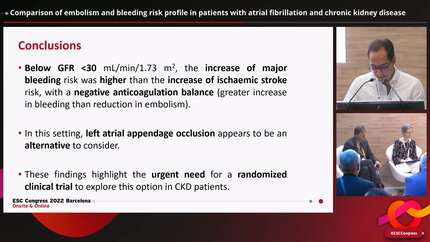
In advanced chronic kidney disease (GFR <30 mL/min/1.73 m2), the increase of major bleeding risk was higher than the increase of ischaemic stroke risk, with a negative anticoagulation balance (greater increase in bleeding than reduction in embolism).
In this setting, left atrial appendage occlusion appears to be an alternative to consider.
Type of funding sources: None.
Figure 1
Figure 2
Contributors

J Parada Barcia
Author
S Raposeiras Roubin
Author
E Abu Assi
Author
P Dominguez Erquicia
Author
A Lizancos Castro
Author
A Ledo Pineiro
Author
V Noriega
Author
C Iglesias Otero
Author
A Gonzalez Garcia
Author
A Iniguez Romo
Author
You may be interested in