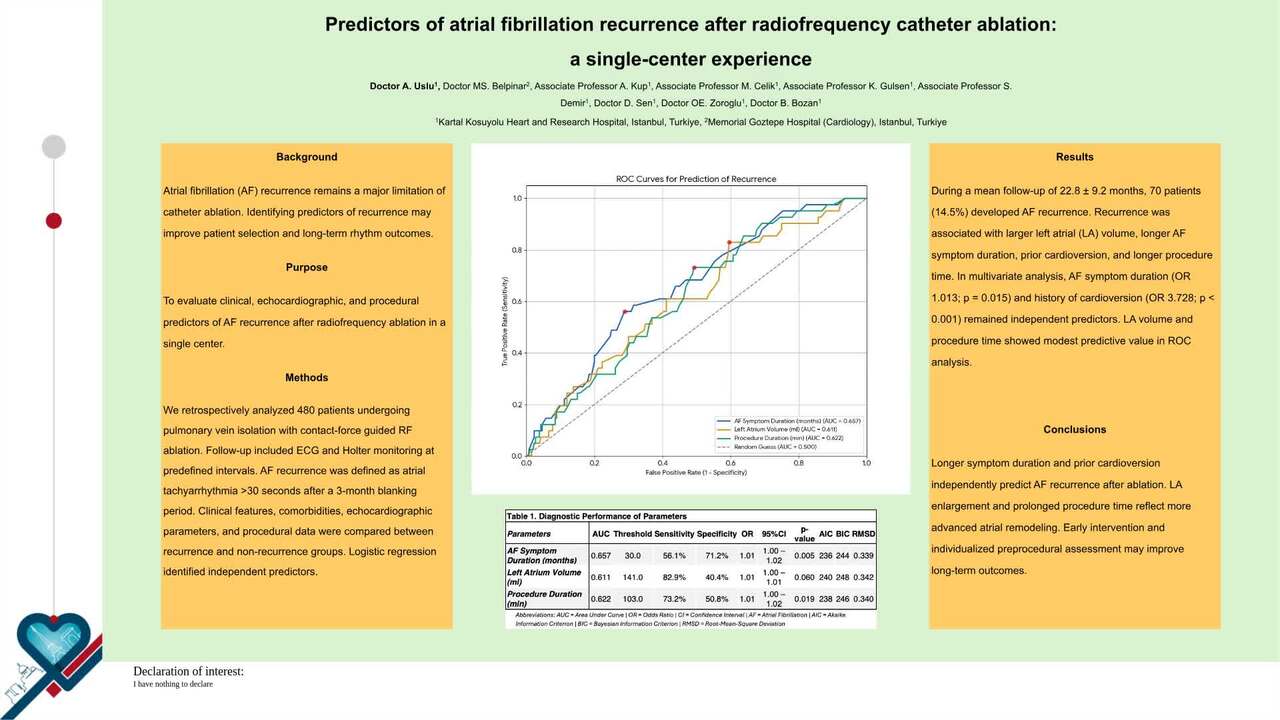
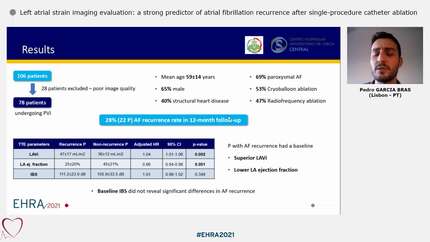
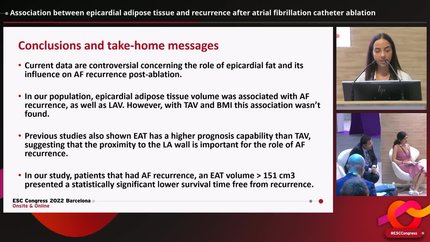
Predictors of long-term atrial fibrillation recurrence after catheter ablation: non-linear analytical approach for individualized prognostic stratification
European Heart Journal


Abstract
Recurrences are common in patients with atrial fibrillation (AF) during long-term follow-up after catheter ablation (CA) for pulmonary vein isolation (PVI). Recently, machine learning (ML) models identifying non-linear relationships among various patient parameters have been applied for prognostic stratification in different cardiac diseases.
This is a retrospective study aimed to determine whether ML-based models can identify non-linear relationships in individual clinical baseline characteristics and CT-quantified volumetric parameters of epicardial fat tissue (EFT) to aid in prognosing outcome of catheter ablation for PVI in patients with paroxysmal AF.
A cohort of 92 patients (median age 60.2 [51.9–64.0]; 74% male) with paroxysmal AF (a single persistent AF episode was accepted) undergoing catheter ablation targeting PVI was analysed. All patients underwent cardiac CT imaging and were fitted with implantable loop recorder (ILR) prior to CA. For PVI, radiofrequency CA with electro-anatomical mapping was used in 79 patients, cryoballoon ablation in 13 patients. AF recurrence, defined as AF burden >0.1% after the blanking period (90 days), was continuously assessed by ILR. Feature selection on 23 baseline parameters was performed using random forest models (XGBoostRegressor). Mean absolute Shapley values (|mSHAP| – Shapley Additive expLanations) were used to quantify the relative discriminative power of analysed parameters.
During a follow-up of 3-years, AF recurrence was detected in 58 (63%) patients, 29 (50%) of them underwent a repeat ablation. Five most important predictors of AF recurrence during 3-year follow-up were upper epicardial fat volume, BMI, baseline AF burden, age and pericardial volume (lower segment) (Fig. 1). Upper EFT volume was twice as important for males than females (0.44 and 0.21 |mSHAP| respectively). For a patient with no AF recurrence, low age (41 years) and low upper EFT volume (13.2 ml) were the most important drivers predicting positive ablation outcome (Fig. 2A). In contrast, in a patient with AF recurrence post CA, an above-average EFT volume of 55.5 ml and a high BMI had the most significant net contribution for predicting his failed CA outcome (Fig. 2B).
Non-linear ML analysis applied to our limited cohort of patients with paroxysmal AF undergoing CA suggests: i) a significant association of high EFT volume with ILR determined AF recurrence during a 3-year follow-up; ii) potential role of such analyses for a more granular and highly individualized prediction of outcome of planned CA. However, these results need further testing, and validation in prospective trials.
Type of funding sources: None.
Contributors

R Herman
Author
P Hlivak
Author
V Bernat
Author
M Svetlosak
Author
A Demolder
Author
T Palus
Author
L Urban
Author
R Hatala
Author
You may be interested in