Impact of metabolic syndrome on the risk of ischemic stroke in non-anticoagulated atrial fibrillation patients having low CHA2DS2-VASc scores
European Heart Journal


Abstract
Metabolic syndrome (MetS) predisposes to a thromboembolic state. However, conflicting results have been reported on whether MetS confers an increased risk of ischemic stroke in atrial fibrillation (AF), especially in patients with low CHA2DS2-VASc score who are not indicated for oral anticoagulant therapy.
We investigated the risk of ischemic stroke according to the presence of MetS, the number of MetS components (metabolic burden), and the individual metabolic components in non-anticoagulated AF patients with low CHA2DS2-VASc score.
A total of 76,015 oral anticoagulant-naïve AF patients with low CHA2DS2-VASc score (0,1 in male and 1 in female) were included from the Korean National Health Insurance Service database. The status of MetS and individual metabolic components were evaluated based on health examination data within two years of AF diagnosis. We estimated the risk of ischemic stroke according to MetS, metabolic burden, and an individual component of MetS using Cox proportional-hazards models.
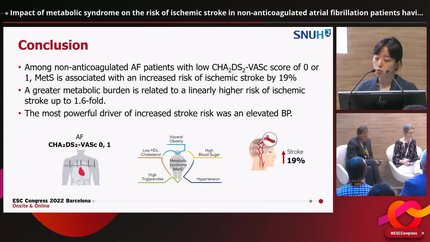
The mean age was 49.8±11.1 years and 52,388 (68.9%) were male. The average CHA2DS2-VASc score was 0.7±0.5 and MetS was prevalent among 21,570 (28.4%) of the study population. During a mean follow-up of 5.1 years, ischemic stroke was developed in 1,395 (1.84%) patients. MetS was associated with a higher risk of ischemic stroke after adjustment for age, sex, lifestyle behaviors, low income, and cardiovascular comorbidities: adjusted hazard ratio (aHR) 1.19, 95% confidence interval (CI) 1.06–1.33, p=0.002. A positive linear correlation was observed between metabolic burden and ischemic stroke risk. Patients with five MetS components showed the highest aHR of 1.55 (95% CI 1.14–2.11, Figure 1 and Figure 2), whereas those with a single MetS component had a marginal risk of ischemic stroke (aHR 1.18, 95% CI 0.99–1.41). Among individual metabolic components, elevated blood pressure and increased waist circumference was significantly associated with an increased risk of ischemic stroke: aHR (95% CI), 1.45 (1.30–1.62), p<0.001, and 1.15 (1.03–1.30), p=0.016, respectively.
Among AF patients initially with CHA2DS2-VASc score 0 and 1 with no anticoagulation, the presence of MetS is associated with an increased risk of ischemic stroke. Given the linear incremental correlation between metabolic burden and ischemic stroke, special attention to the care of metabolic derangements is required in AF patients who are not indicated for anticoagulation.
Type of funding sources: None.

You may be interested in