Lower recurrence rates of atrial fibrillation in early compared to late ablation – a Danish nationwide study
European Heart Journal


Abstract
Guidelines recommend antiarrhythmic drugs (AAD) before ablation for atrial fibrillation (AF). However, recently published randomized clinical trials have demonstrated that ablation is more effective in maintaining sinus rhythm compared to AAD as first line therapy. Therefore, data pertaining the impact of early ablation on AF recurrence in large, unselected cohorts is highly warranted.
To examine clinically relevant AF recurrence after ablation by time from AF diagnosis to ablation.
Using Danish nationwide registries, all Danish patients above 18 years who underwent first-time AF ablation from January1st 2010 to December31st 2018 were identified and included at the date of ablation. The patients were categorized by time from diagnosis with AF to ablation. Recurrent AF was defined using a composite endpoint comprising claimed prescriptions of AAD, hospital admissions due to AF, re-ablation, or electrical cardioversions. The cumulative incidence of recurrent AF by time from diagnosis to ablation at 1-year follow-up after a blanking period of 90 days, was estimated using the Aalen-Johansen estimator, taking death as a competing risk into account. The relative rates of recurrent AF by time from diagnosis to ablation were examined using Cox models adjusted for sex, age, procedure-year, heart failure, ischemic heart disease, chronic obstructive pulmonary disease, chronic kidney disease, hypertension, and diabetes.
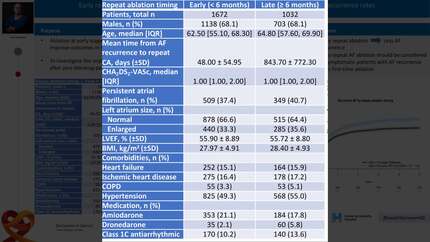
The study cohort consisted of 8,098 patients. Median age [IQR] increased from 60 [52 to 66] in the early ablation group (AF ablation within 1 year after diagnosis) to 64 [57 to 70] in the late ablation group (ablation at least 3 years after diagnosis). The number of patients with a CHA2DS2-VASc score of 2 or more increased from 44% in the early ablation group to 51% in the late ablation group. Use of amiodarone remained stable, while use of Class IC anti-arrhythmic medication increased by time from diagnosis to ablation.
Figure 1 shows the 1-year cumulative incidence of recurrent AF, hazard ratios (HR), and 95% confidence intervals (95% CI) stratified by time from diagnosis to ablation in years and depict that the risk of recurrent AF increased incrementally and significantly by time from diagnosis to ablation compared to the early ablation group.
Figure 2 shows the 1-year cumulative incidence of recurrent AF, hazard ratios (HR), and 95% confidence intervals (CI 95%) stratified by time from diagnosis to ablation in months and depict that very early ablation (within 6 months) is associated with less recurrent AF.
In this large nationwide study examining recurrent AF post ablation, recurrence rates of AF increased incrementally according to time from AF diagnosis to AF ablation. Early ablation could potentially provide substantial benefits and improve outcomes after ablation, indicating ablation as first-line therapy might be more ideal.
Type of funding sources: None.
Figure 1
Figure 2
Contributors

J Toennesen
Author
J L P Pallisgaard
Author
P V R Rasmussen
Author
M R Ruwald
Author
C Z Zoerner
Author
G G Gislason
Author
M L H Hansen
Author
You may be interested in