The first Brazilian cardiovascular registry of atrial fibrillation: the primary results of the RECALL study
European Heart Journal


Abstract
There is limited prospective real-world evidence of patients with atrial fibrillation (AF) in Latin America.
The rationale and design of the study were previously published (1). Briefly, RECALL was the first nationwide prospective study of patients in Brazil with known atrial fibrillation. A total of 4,585 patients were included among 89 sites from April 2012 to August 2019. All patients were followed for one year by the protocol. Patient characteristics, medications under use and clinical outcomes during the follow-up were collected.
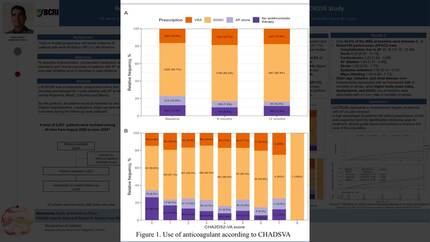
From the total of patients enrolled, 41 were excluded from the analysis since they did not have a confirmed diagnosis of atrial fibrillation. The median age was 70 (61–78) years, 46% were women and the majority of the cases were permanent AF (53,8%). The mean CHA2DS2VASc was 3.2±1.6 and the median HASBLED was 2 [2–3]. The most common risk factor was arterial hypertension (77.9%). The median heart rate was 74 [65–85] and the mean ejection fraction was 52.2±2.6 (%). Only 4.4% of patients had history of previous ablation and 30.4% were using anti-arrhythmic. At baseline, 22.0% did not use anticoagulants (Figure 1) and 9.1% did not use any antithrombotic therapy. The most common anticoagulant was vitamin K antagonist – VKA (62.6%) while the remaining 37.4% were direct oral anticoagulants. The main reasons for not using an oral anticoagulant were physician judgment's (low risk of stroke – 24.6%) and difficult to control (14.7%) or perform INR (9.9%) while patient preference and adverse event represented respectively 5.3% and 4.1%, respectively. Only 42.5% of the INRs at baseline were between 2 and 3. During follow-up, the use of anticoagulants and INR in the therapeutic range increased to 87.1% and 59.1%, respectively. In one year, 17.8% of patients were hospitalized due to atrial fibrillation. At 1 year, the rates of death, stroke, systemic embolism and major bleeding were 5.76 [5.12–6.47], 2.77 [2.32–3.32] 1.01 [0.75–1.36], 2.21 [1.81–2.70], respectively. Among VKA users, the rate of mortality and bleeding was higher in the group with time in therapeutic range below 60% (Figure 2).
RECALL represents the largest prospective registry of patients with atrial fibrillation in Latin America. Our findings highlight important gaps in the treatment of patients which can inform clinical practice and help to guide future interventions to improve the care of these patients.
Type of funding sources: Other. Main funding source(s): Brazilian Society of Cardiology
Figure 1. Atrial fibrillation therapies in 1-year
Figure 2. Mortality and major bleeding vs. TTR
Contributors

R D Lopes
Author
P G Barros E Silva
Author
C R Hoffmann Filho
Author
M A Cavalvante
Author
C M Miranda
Author
R B Esper
Author
G G De Lima
Author
L E F Ritt
Author
R M F L Silva
Author
M Nakazone
Author
L I Zimerman
Author
O F De Souza
Author
A A Fagundes
Author
E B Saad
Author
R A Teixeira
Author
You may be interested in