Prediction of incident atrial fibrillation with GDF-15 and echocardiographic left atrial volumes: data from the Akershus cardiac examination 1950 study
European Heart Journal


Abstract
Left atrial structural remodeling is associated with the risk of incident atrial fibrillation, but there is uncertainty as to what echocardiographic left atrial indices that best predict incident atrial fibrillation. GDF-15 is a marker of oxidative stress and inflammation that is closely associated with the risk of stroke, bleeding and mortality in patients with atrial fibrillation. There is, however, limited data regarding its relation with left atrial remodeling and incident atrial fibrillation in the general population.
To investigate the association between GDF-15 and left atrial volumes, and their prognostic properties for incident atrial fibrillation in a general population cohort.
The Akershus Cardiac Examination 1950 Study is a population-based cohort of individuals born in 1950. Comprehensive baseline examinations were performed for 3706 study participants in 2012–2015. Left atrial maximum and minimum volumes were measured, indexed to body surface area yielding LAVimax and LAVimin. Left atrial emptying fraction (LAEF) was calculated as ((LAVimax - LAVimin)/LAVimax)x100%. Individuals with known atrial fibrillation at baseline (n=166) were excluded, leaving 3540 included in this analysis. National health registries provided clinical outcome data regarding atrial fibrillation and death from any cause. Incident atrial fibrillation cases were validated by health records. Atrial flutter was included in the outcome definition. The CHARGE-AF risk score for atrial fibrillation was quantified. Prediction of incident atrial fibrillation was assessed by Cox proportional hazards regression models and visualised by Kaplan-Meier plots.
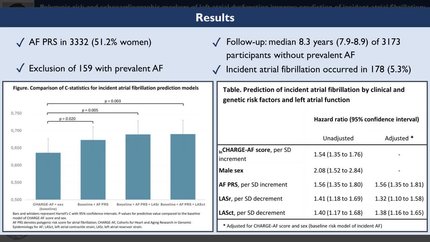
Mean age at baseline was 63.9±0.7 years and 1763 (49.8%) were female. GDF-15 correlated weakly with LAVimax (r=−0.07, p<0.001) and LAVimin (r=−0.05 p=0.007), but not with LAEF (r=−0.01, p=0.61). During a median follow-up of 6.4 years, incident atrial fibrillation occurred in 135 (3.8%) individuals. Subjects who developed atrial fibrillation had larger LAVimax (30.1±8.3 vs. 26.2±6.9 mL/m2; p<0.001), larger LAVimin (17.1±7.1 vs. 14.1±4.7 mL/m2; p<0.001), and lower LAEF (44.3±10.7 vs. 46.3±9.0%; p=0.019). Concentrations of GDF-15 were not significantly different in those who experienced atrial fibrillation (median 850 [670–1107] vs. 790 [630–1020] ng/L; p=0.06). Left atrial volumes and LAEF, but not GDF-15, were associated with incident atrial fibrillation (Table 1 and Figure 1).
In this population-based cohort study, LAVimax, LAVimin, and LAEF predicted incident atrial fibrillation independently of the CHARGE-AF risk score. GDF-15 was not significantly associated with left atrial structural remodeling or with increased risk of incident atrial fibrillation.
Type of funding sources: Public hospital(s). Main funding source(s): Vestre Viken HF, Hospital TrustAkershus University Hospital
Contributors

P S Roenningen
Author
M N Lyngbakken
Author
M G Solberg
Author
T Berge
Author
J Brynildsen
Author
E N Aagaard
Author
B Kvisvik
Author
H Rosjo
Author
K Steine
Author
A Tveit
Author
T Omland
Author
You may be interested in