What is there to EAARN with a CRT implantation? Predictive factors of mortality or clinical deterioration in patients receiving cardiac resynchronization therapy based on pre-implant factors
European Heart Journal


Abstract
Cardiac resynchronization therapy (CRT) in heart failure patients with reduced ejection fraction (HFrEF) and wide QRS complexes has been shown to improve both functional capacity and quality of life, and to decrease hospital admissions and mortality. Mortality in CRT patients has been associated with several pre-implant risk factors and some risk scores, like the EAARN score, have been developed to try and predict mortality and morbidity in this population.
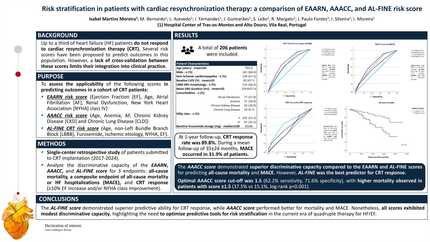
Our aim was to assess risk factors for a compositive end-point of admissions for heart failure or cardiovascular death at 5 years, particularly the EAARN SCORE (EF, Age, Atrial Fibrillation (AF), Renal dysfunction, New York Heart Association (NYHA) class IV), in patients with EF <35% and QRS >130ms submitted to CRT implantation.
We performed a retrospective analysis between 2012 and May of 2019 of all patients admitted for CRT implantation due to HFrEF with EF <35% and QRS >130ms in a single expert centre. Medical records were analysed for clinical, procedural data and outcomes. The predictive accuracy of the score was assessed using the area under curve (AUC) of receiver operating characteristics (ROC) curve. The association between EAARN and the composite end-point at 5-years was analyzed using a Cox regression model.
Of the 134 patients assessed, 101 patients fulfilled all inclusion criteria. The mean age at implantation was 70.2±10 years with a male preponderance (67.2%).
This population was significantly symptomatic, with 35% in NYHA class II, 58% in NYHA class III and 5% in NYHA class IV. Most had an ischemic etiology (74.2%). 75% of patients were considered responders after implantation (NYHA improvement of at least 1 class and/or increase in 10% in EF). A primary composite end-point occurred in 17.8% of patients. The pre-procedure characteristics associated with an event were an ischemic etiology (OR 4.66; CI 95% 1.52–14.24, p<0.05) and pre-procedure EF (OR 0.81; CI 95% 0.81–0.97, p<0.05). The age, sex, NYHA class, presence of AF, renal function, bundle branch block morphology and responder status were non significant. The EAARN Score showed predictive power for the occurrence of an event (OR 1.95; CI 95% 1.13–3.36, p<0.05) and a reasonable discriminative capacity with the ROC curve analysis (figure 1A) demonstrating an AUC of 0.70. The survival analysis (figure 1B) with a Hazard Ratio of 1.88 (CI 95% 1.158–3.058, p<0.05) signifying an increased risk of an event of 88% per EAARN class increase, with the Kaplan Meier curves widening significantly in the different categories of the score.
In patients who implanted a CRT due to HFrEF with EF <35% and QRS >130ms the EAARN score demonstrated a good predictive power and discriminative capacity for admission for heart failure or cardiovascular death at 5 years although it does not account for the etiology which was also a significant factor.
Type of funding sources: None.
Figure 1
Contributors

J Grade Santos
Author
A Briosa
Author
B Ferreira
Author
M Martinho
Author
D Cunha
Author
K Budzak
Author
J Simoes
Author
C Alvarenga
Author
R Miranda
Author
S Almeida
Author
L Brandao
Author
H Pereira
Author
You may be interested in