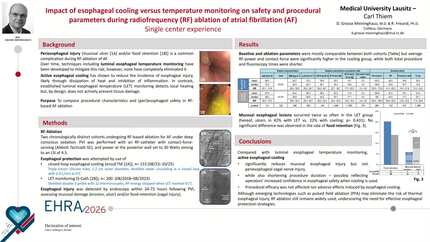
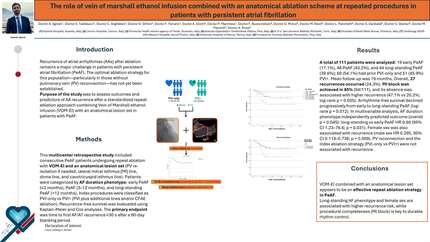
Esophageal cooling during ablation of persistent atrial fibrillation is associated with improved freedom from arrhythmia at one-year follow up
European Heart Journal


Abstract
Various factors influence successful freedom from atrial arrhythmia after pulmonary vein isolation (PVI) with radiofrequency (RF) ablation for the treatment of atrial fibrillation (AF). Lesion transmurality and continuity (as measured by the Continuity Index) are two important factors, and these can be worsened by pauses in RF energy application due to esophageal overheating. Proactive esophageal cooling precludes the need for premature cessation of power, avoiding partially-formed lesions and the need to “hop-scotch” in the left atrium. The resulting improvement in lesion continuity may improve long-term freedom from atrial arrhythmia after PVI, particularly in patients with persistent AF, where more posterior wall ablation is often necessary.
Determine differences in freedom from arrhythmia at one year between patients receiving LET monitoring and those receiving esophageal cooling during PVI for persistent AF.
We reviewed data from two healthcare systems for patient rhythm status at one-year follow up after PVI for the treatment of persistent or long-standing persistent AF. We then determined Kaplan-Meier estimates of freedom from arrhythmia (AF, atrial flutter, and atrial tachycardia), and compared these between patients receiving esophageal cooling and those treated with traditional LET monitoring.
A total of 252 patients received PVI for persistent or long-standing persistent AF and had data available for review. Of these, 148 received LET monitoring (with either a single or multi-sensor temperature probe), and 104 received active cooling with a dedicated esophageal cooling device. Mean age and gender for each group was similar (67.2, range 21 to 88 years, 36% female for LET monitoring, and 67.8, range 32 to 89 years, 30% female for esophageal cooling). KM estimates for freedom from AF at the one-year follow-up were 44.2% for LET monitored patients and 79.3% for actively cooled patients (P=0.01).
Freedom from atrial arrhythmia at one-year after PVI for persistent AF is associated with significant improvement when using active esophageal cooling rather than LET monitoring.
Type of funding sources: Private company. Main funding source(s): Attune Medical
Contributors

C Joseph
Author
J Nazari
Author
J Zagrodzky
Author
J Sherman
Author
W Zagrodzky
Author
S Bailey
Author
A Ro
Author
W Fisher
Author
M Metzl
Author
You may be interested in