Abstract
Atrioventricular-nodal reentry tachycardia (AVNRT) is a common supraventricular tachycardia, particularly in younger patients. First-line therapy in symptomatic patients is radiofrequency catheter ablation (RFCA). Catheter placement and ablation are typically performed by fluoroscopy guidance implying a non-negligible exposure of ionizing radiation for patient and laboratory personnel.
We aimed to demonstrate feasibility and safety of AVNRT ablation using 3D-electroanatomic mapping (3D-EAM) as sole and additional means of catheter guidance compared to conventional fluoroscopic positioning. Endpoints were: procedure duration, fluoroscopy duration, radiation dose and occurrence of any complication.
We retrospectively included consecutive patients (n=68, mean age 55±18 years) who underwent RFCA of AVNRT between 01/2020 and 12/2021 in our hospital. One group was a priori allocated to conventional fluoroscopy mapping (convFluoro, n=30), the other procedures were performed under 3D-EAM using Ensite NavX (NavX). From the latter, slow-pathway RFCA could be performed without any fluoroscopy (zeroFluoro) in 20 patients, in 18 cases additionally fluoroscopy was used due to difficult anatomic conditions (NavX+Fluoro). Success of RFCA was defined as slow-pathway elimination.
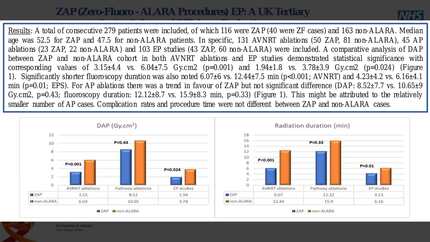
There was no significant difference in procedure duration between the convFluoro and overall NavX group (74±24 min vs. 87±29 min, P=NS). However, NavX+Fluoro group (comprising more complicated cases) had longer procedure duration compared to convFluoro group (94±30 min vs. 74±24 min, p<0.05). The use of 3D-EAM significantly reduced fluoroscopy duration comparing convFluoro with NavX+Fluoro (12±9 min vs. 7±6 min, p<0.05) and convFluoro with overall NavX-group (12±9 min vs. 3±5 min, p<0.0001). Likewise, radiation dose was significantly decreased by means of 3D-EAM (NavX: 60±113 cG cm2 vs. convFluoro: 169±166 cG cm2, p<0.01). 3D-EAM guided RFCA was successful in all patients (100%), success rate in convFluoro-group was 87% (P=NS). Minor complications occurred in two cases (7%) in the convFluoro-group and 4 cases (11%) in the NavX-group (P=NS). No severe complication, such as pericardial effusion or permanent AV-block occurred in any group.
Zero-fluoroscopy 3D-EAM-guided RFCA in patients with AVNRT is feasible and safe. Without prolonging procedure duration, 3D-EAM can reduce fluoroscopy duration leading to lower radiation exposure and making electrophysiological study safer for laboratory staff and patients.
Type of funding sources: None.
RFCA of the slow pathway (red tags)
Contributors

You may be interested in