Chronic amiodarone therapy and mortality among atrial fibrillation patients; insights from a real-life contemporary population
European Heart Journal


Abstract
Although associated with potentially serious side effects, amiodarone is the most effective pharmacotherapy to achieve rhythm control among patients with atrial fibrillation (AF). Recent clinical trials advocate early rhythm control in AF. The effect of amiodarone treatment on mortality among patients with AF in real-life remains largely debatable. The primary aim of this analysis was to compare all-cause mortality rates across amiodarone treatment status
This is a retrospective study among patients from the Southern district of Clalit Health Services in Israel between January 1st, 1999 and July 1st, 2021 including all prevalent atrial fibrillation cases, hospitalized with AF as a primary diagnosis. Patients treated with amiodarone were matched in a 1:1 manner with controls not exposed to amiodarone based on age, sex, living area, and atrial fibrillation diagnosis duration. To avoid immortal time bias, follow-up times of the matched controls were left adjudicated to truncate the amiodarone-free period of their matched cases. We performed survival analyses using multivariable Cox regression controlling for potential confounders.
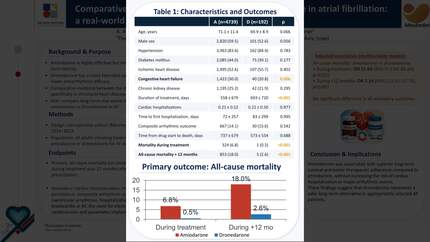
During the study period, 7,048 patients who initiated amiodarone treatment were identified, of whom 6,449 were matched with controls. The mean age was 71.5 years, and 46.4% were women among the matched population. At baseline, the amiodarone-treatment group had higher rates of diabetes (38.3% vs. 32.6%, chronic renal failure (17.2% vs. 10.8%), coronary heart disease (31.6% vs. 19.6%) peripheral vascular disease (13.1% vs. 9.8%), and congestive heart failure (33.8% vs. 20.7%; p<0.001 for all). The amiodarone-treatment group had higher rates of oral-anticoagulant therapy (82.0% vs. 59.4%, p<0.001). During a mean follow-up time of 5.7 years, 2849 (44.2%) patients died in the amiodarone group and 3072 (47.6%) patients in the control group [adjusted-hazard-ratio: 0.85 (confidence-interval 95%: 0.80,0.91), p<0.001].
In a large contemporary real-life population with AF, amiodarone treatment was associated with a lower risk for death, despite a higher burden of comorbidities among patients treated with amiodarone. These results support findings from randomized clinical trials advocating aggressive rhythm control therapy to reduce mortality and suggest that amiodarone is a potentially effective treatment to achieve this aim.
Type of funding sources: None.
Adjusted survival, all-cause mortality
Contributors

G Tsaban
Author
M Gordon
Author
Y Omari
Author
L Kezerle
Author
H Alnsasra
Author
K Buturlin
Author
S Bareza
Author
A Wagshal
Author
V Novack
Author
Y Konstantino
Author
M Haim
Author
You may be interested in