Absence of atrial fibrillation in the blanking period following cryoballoon pulmonary vein isolation – does it always portend a good prognosis?
European Heart Journal


Abstract
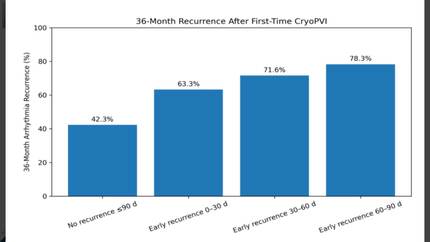
Cryoballoon (CB) pulmonary vein isolation (PVI) is an accepted method for ablation in patients with paroxysmal and persistent atrial fibrillation (PAF, PeAF). Freedom from AF in the blanking period (BP), conventionally defined as the first 3-months post-PVI, has been associated with the best long-term outcomes. However, the influence of antiarrhythmic drugs (AADs) during the BP on long-term outcomes is not well understood.
To compare long-term outcomes between patients who were and were not on an AAD prior to ablation and remained free from AF during the 3-month BP post CB PVI.
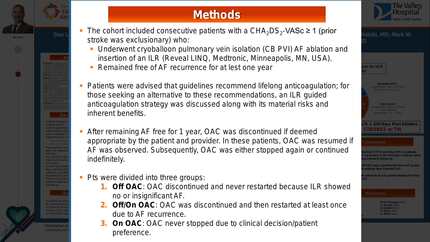
We enrolled consecutive AF patients undergoing CB PVI; all pts had an implantable loop recorder (ILR). No patient had any AF in the first 90 days post CB PVI. We divided the patients into three groups: (1) never had exposure to an AAD; (2) were intolerant to/failed AAD and thus were not taking an AAD at time of ablation; and (3) were on AAD at time of ablation. In the latter group, every effort was made to stop the AAD before the end of the BP.
The cohort included 96 pts (66±10 years; 60 [63%] male; 55 [57%] PAF; CHA2DS2-VASc 2.5±1.4). There were 23 (24%) patients in group 1, 13 (14%) patients in group 2, and 60 (63%) pts in group 3. Patients in group 3 were more likely to have PeAF; AADs were stopped at a median of 36 days IQR (27, 91) in this group. Patients were followed for 1-year during which time 28 (29%) patients had recurrent AF (despite having no AF during the BP). The best outcome was seen in patients who never used an AAD; the worst outcome was seen in patients who were on an AAD at time of ablation (Figure 1).
Our data show that absence of AF during a 3-month post CB PVI BP alone does not guarantee good-long term outcome, unless the patient was never treated with an AAD. In contrast, in patients ablated while taking an AAD, recurrent AF was observed in 37% even though they were completely AF-free during the BP.
Type of funding sources: None.
Figure 1
Contributors

N Milstein
Author
M Saberito
Author
A Bhatt
Author
M Habibi
Author
T Sichrovsky
Author
M Preminger
Author
R Shaw
Author
S Mittal
Author
D Musat
Author
You may be interested in