QFR vs. perfusion imaging to predict abnormal FFR in patients with prior coronary artery disease
European Heart Journal


Abstract
In patients with suspected obstructive coronary artery disease (CAD) and a high pre-test probability, myocardial perfusion imaging (MPI) or referral for invasive coronary angiography (ICA) are viable diagnostic strategies. The present study compared the diagnostic performance of quantitative flow ratio (QFR) and MPI by single-photon emission computed tomography (SPECT), positron emission tomography (PET), and cardiac magnetic resonance imaging (CMR).
In this PACIFIC-II substudy, 189 patients with prior MI/PCI who were suspected of having symptoms related to myocardial ischemia and underwent SPECT, PET, and CMR before ICA were evaluated for inclusion. ICA was obtained with (109 patients) and without (80 patients) adherence to a QFR acquisition protocol. All major coronary arteries were interrogated by FFR, except for vessels with a subtotal/total occlusion. An FFR ≤0.80 was used to define significant epicardial CAD. QFR analyses (v2.0) were performed based on ICA by a corelab in vascular territories (N=487) in which FFR was obtained. MPI modalities were assessed for presence of ischemia by corelabs, uninterpretable scans were omitted from the diagnostic comparison analyses.
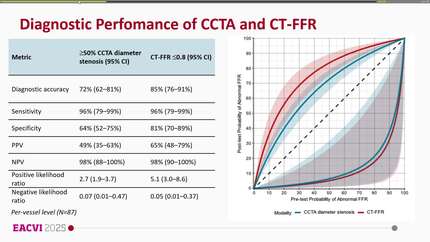
QFR analysis success rate was higher (81%) among vessels acquired using the QFR acquisition protocol compared to vessels obtained without the protocol (52%, p<0.001). Overall, a QFR result was available in 334 (69%) vessels. Among these vessels, QFR had a higher sensitivity (72%) and accuracy (84%) compared to SPECT (46%, p=0.001 and 66%, p<0.001), PET (58%, p=0.032 and 65%, p<0.001), and CMR (33%, p<0.001 and 72%, p<0.001). Whereas specificity of QFR (87%) was similar to CMR (83%, p=0.123) but higher than that of SPECT (71%, p<0.001) and PET (67%, p<0.001). Lastly, QFR exhibited a higher area under the receiver operating characteristic curve (0.89) than SPECT (0.57, p<0.001), PET (0.66, p<0.001), and CMR (0.60, p<0.001).
Provided QFR was analyzable (69% of the vessels), QFR correlated better with FFR (both as measures of epicardial CAD) than MPI as reflected in the diagnostic performance measures for detecting vessels-specific significant epicardial CAD as defined by FFR.
Type of funding sources: None.
Correlation of QFR and FFR
AUCs among patients with and without MI
Contributors

P A Van Diemen
Author
R W De Winter
Author
P G Raijmakers
Author
T Maaniitty
Author
L F Robbers
Author
M B Von Bartheld
Author
A Demirkiran
Author
A C Van Rossum
Author
J H Reiber
Author
S R Underwood
Author
J Knuuti
Author
E Nagel
Author
P Knaapen
Author
R S Driessen
Author
I Danad
Author
You may be interested in