Novel echocardiography-based algorithms to identify severe aortic or mitral regurgitation by cardiac magnetic resonance imaging: a prospective multi-modality imaging study
European Heart Journal


Abstract
Magnetic resonance imaging (MRI) has shown incremental prognostic value to transthoracic echocardiography (TTE) for valve diseases, however TTE remains more widely available and utilized. We sought to develop TTE-based algorithms that best identify severe AR and MR by MRI in a prospective study.
Patients with >moderate-to-severe AR (n=101) and MR (n=71) undergoing both TTE and CMR within 3-months (median 1 day) were prospectively studied. Correlation analyses were performed, and TTE-based decision tree regression algorithms were derived to best identify CMR-defined severe AR and MR (regurgitant fraction >40% and >33% respectively).
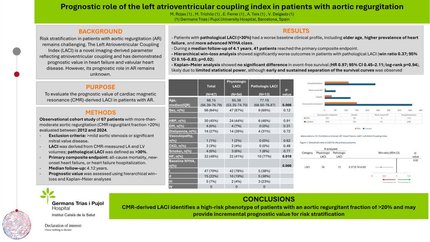
Mean regurgitant volumes/fractions by TTE were 15 mL/18% and 13mL/18% higher than CMR in AR and MR respectively. Decision-tree analyses found regurgitant volume >50 mL and left ventricular end-systolic volume indexed >38 mL/m2 by TTE to best identify CMR-derived severe AR, and regurgitant fraction >50% and left ventricular stroke volume indexed >39 mL/m2 by TTE to best identify CMR-derived severe MR (Figure 1). Their areas under curve compared with current guidelines criteria were 0.75 versus 0.63 (P=0.038) for severe AR, and 0.80 versus 0.67 (P=0.017) for severe MR.
Novel TTE-based algorithms were devised to identify severe MRI-derived AR and MR, superior to the more complex multi-parametric criteria of current TTE guidelines.
Type of funding sources: None.
Figure 1
Contributors

T K M Wang
Author
R A Grimm
Author
Z B Popovic
Author
L L Rodriguez
Author
M A Bolen
Author
N Chann
Author
L A Moennich
Author
K Rutkowski
Author
B P Griffin
Author
S D Flamm
Author
D H Kwon
Author
You may be interested in