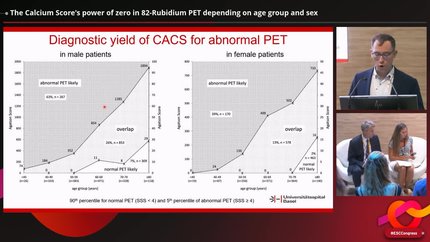
The Calcium Score's power of zero in 82-Rubidium PET depending on age group and sex
European Heart Journal


Abstract
Coronary calcium score (CAC) is a well-validated method to detect coronary artery disease (CAD). A significant number of patients referred for functional ischaemia tests reveal a normal result. CAC could be a potential gatekeeper to reduce unnecessary testing.
Study aims were to describe the frequency of zero calcium and its diagnostic power to exclude abnormal perfusion stratified by age and sex in a large cohort undergoing 82-Rubidium Positron Emission Tomography (PET).
All consecutive patients with suspected CAD who were referred for myocardial perfusion PET at our tertiary center between 2016 and 2021 were identified. Baseline and scan related data were extracted from the electronic database. Patients were included for this retrospective analysis if CAC and semi-quantitative analysis of perfusion study were available. Percentiles and test characteristics of zero calcium were calculated stratified by age and sex. Summed stress score (SSS) ≥4 on PET was considered abnormal.
2640 patients were included. Mean age was 65±11 years; 54% were male. Angina and dyspnea were present in 39% and 60%, respectively. 21% (558/2640) of the scans were abnormal and median CAC was 62 [0–374]. 685 patients (26%) had no calcium. Stratified by age, the proportion of zero calcium was 89% (<40 years), 61% (40–49y), 40% (50–59y), 21% (60–69y), 14% (70–79y) and 6% (≥80y). CAC was higher in abnormal scans (median 561 vs. 27, p<0.001) and zero CAC was associated with a lower risk of abnormal PET (2.6% vs. 27.6%, p<0.001). The negative predictive value (NPV) of calcium zero to exclude abnormal PET was 97%, 96% and 98% for all patients, males and females, respectively. Test characteristics are displayed in Table 1. Percentiles of CAC according to scan result are depicted in Figure 1.
The proportion of zero calcium is frequent and declines with increasing age. The absence of coronary calcium is associated with less abnormal PET scans. Zero calcium to exclude an abnormal scan performed best in young patients (<50) with a NPV ≥98%. CAC could act as a gatekeeper. However, further studies including safety endpoints are needed.
The upper calcium score indicates the 90th percentile of patients with normal PET. The lower calcium score indicates the 5th percentile of patients with abnormal PET. Calcium scores within the white area are unlikely to be associated with abnormal PET (since this area includes only the 5% of abnormal PET scans). The dark grey area indicates patients with a high likelihood of positive PET. For better readability, different scales were used.
Type of funding sources: None.
Table 1. Negative predictive value and sensitivity of CAC ≥1 for abnormal PET (SSS≥4) stratified by age groups and sex. Npv: negative predictive values. Brackets indicating 95% confidence interval. Due to low number, the first age groups were taken together in women.
Figure 1. Diagnostic yield of calcium score.
Contributors

S Frey
Author
O F Clerc
Author
M Amrein
Author
K Thommen
Author
K Leu
Author
F Caobelli
Author
P Haaf
Author
M J Zellweger
Author
You may be interested in