Association between inflammation and left ventricular thrombus formation following ST-elevation myocardial infarction
European Heart Journal


Abstract
Current evidence suggests a link between the inflammatory state and left ventricular thrombus (LVT) formation following ST-elevation myocardial infarction (STEMI). However, a comprehensive study investigating the association between inflammatory biomarkers and LVT diagnosed by cardiac magnetic resonance (CMR) is lacking.
The present study aimed to investigate the association of biochemical markers of inflammation with LVT as assessed by CMR imaging among patients with STEMI.
We studied 309 patients with acute STEMI treated with primary percutaneous coronary intervention (pPCI) from the prospective MARINA-STEMI cohort study. Concentrations of high-sensitivity C-reactive protein (hs-CRP), interleukin-6 (IL-6), white blood cell count (WBCc), fibrinogen and D-dimer were measured two days after STEMI. Infarct characteristics and presence of LVT were assessed with the use of contrast-enhanced CMR at a median of 4 (interquartile range [IQR] 3–5) days after pPCI.
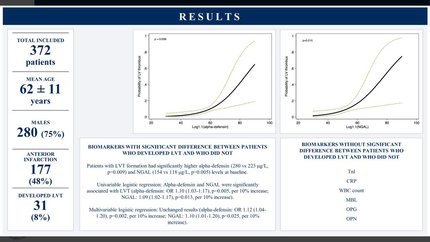
In total, 309 STEMI patients (18% female) with a median age of 57 (IQR 52–65) years were included. An LVT was observed in 8% (n=24) of the overall cohort and in 15% of patients with an anterior STEMI. Hs-CRP (OR: 2.16, 95% CI: 1.54–3.02, p<0.001), IL-6 (OR: 2.38, 95% CI: 1.48–3.81, p<0.001) and fibrinogen levels (OR: 2.05, 95% CI: 1.40–3.00, p<0.001) were significantly associated with presence of LVT. Among all assessed inflammatory biomarkers, only hs-CRP was independently associated with LVT after adjustment for markers of inflammation and CMR parameters (OR: 1.77, 95% CI: 1.21–2.59, p=0.004).
In patients with STEMI treated with pPCI, inflammatory markers (hs-CRP, IL-6 and fibrinogen) are associated with the presence of LVT. However, only hs-CRP was independently associated with the occurrence of LVT, highlighting the key role of CRP as clinical risk marker for LVT formation in STEMI patients treated with pPCI.
Type of funding sources: Public Institution(s). Main funding source(s): Austrian Science Fund (FWF)Austrian Society of Cardiology
Figure 1
Contributors

M Holzknecht
Author
I Lechner
Author
M Reindl
Author
C Tiller
Author
P Fink
Author
A Mayr
Author
G Klug
Author
A Bauer
Author
S J Reinstadler
Author
B Metzler
Author
You may be interested in