Incremental prognostic value of stress CMR in symptomatic patients with coronary stenosis on CCTA
European Heart Journal


Abstract
Noninvasive functional imaging is often performed in patients with obstructive coronary artery disease (CAD) on coronary computed tomography angiography (CCTA). However, the prognostic value of stress cardiovascular magnetic resonance (CMR) is unknown in patients with coronary stenosis of unknown significance on CCTA.
To assess the prognostic value of stress CMR in symptomatic patients with obstructive CAD of unknown significance on CCTA.
Between 2008–2020, consecutive symptomatic patients without known CAD referred for CCTA were screened. Patients with obstructive CAD (at least 1 ≥50% stenosis on CCTA) were further referred for stress CMR and followed for the occurrence of major adverse cardiovascular events (MACE), defined by cardiovascular death or nonfatal myocardial infarction.
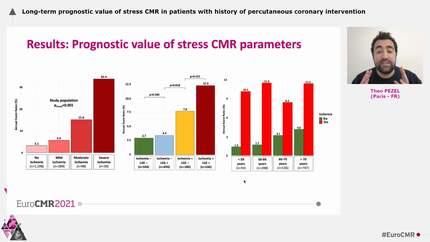
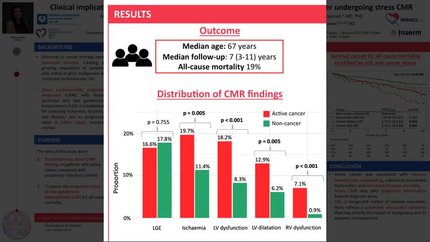
Of 2,210 patients who completed CMR, 2,038 (46.5% male, mean age 69.8±12.2 years) completed follow-up (median 6.8 [IQR 5.9–9.2] years); 281 experienced a MACE (13.8%). Inducible ischemia and late gadolinium enhancement (LGE) were significantly associated with MACE (HR: 4.51, [95% CI: 3.55–5.74]; and HR: 3.32, [95% CI: 2.55–4.32], respectively; p<0.001). In multivariable Cox regression, number of segments with >70% stenosis, with noncalcified plaques and number of vessels with obstructive CAD were prognosticators (p<0.001). The presence of inducible ischemia and LGE were independent predictors of MACE (HR: 3.97, [95% CI: 3.43–5.13]; HR: 2.30, [95% CI: 1.52–3.33]; p<0.001). After adjustment, stress CMR showed the best improvement in model discrimination and reclassification above traditional risk factors and CCTA (C-statistic improvement: 0.04; NRI=0.421; IDI=0.047).
In symptomatic patients with obstructive CAD of unknown significance on CCTA, stress CMR had incremental prognostic value to predict MACE.
Type of funding sources: None.
Kaplan-Meier curves for Ischemia
Competitive risk analysis for Ischemia
Contributors

T Pezel
Author
T Hovasse
Author
T Lefevre
Author
F Sanguineti
Author
S Champagne
Author
H Benamer
Author
A Neylon
Author
S Toupin
Author
P Garot
Author
B Chevalier
Author
J Garot
Author
You may be interested in