Incremental prognostic value of stress CMR for cardiovascular risk stratification after a cryptogenic ischemic stroke
European Heart Journal


Abstract
One-third of ischemic strokes are “cryptogenic” without clearly identified etiology. Although coronary artery disease (CAD) is the main cause of death after stroke, the interest of CAD screening in patients with cryptogenic stroke is still debated.
The aim of the study was to assess the incremental prognostic value of stress cardiovascular magnetic resonance (CMR) beyond traditional risk factors for predicting cardiovascular events in patients with a prior cryptogenic ischemic stroke.
Between 2008 and 2021, consecutive patients with prior cryptogenic strokes referred for stress CMR were included and followed for the occurrence of major adverse cardiovascular events (MACE), defined by cardiovascular death or nonfatal myocardial infarction (MI). Univariable and multivariable Cox regressions were performed to determine the prognostic value of unrecognized MI and silent ischemia.
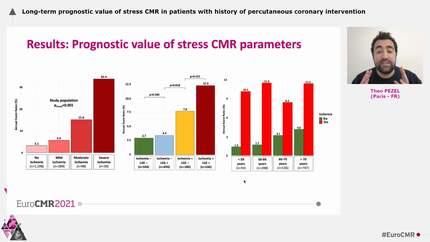
Of 542 patients (55.2% male, mean age 71.4±8.8 years) who completed the follow-up (median 5.9 years), 66 (12.2%) experienced MACE. Silent ischemia and unrecognized MI were detected in 18% and 17% of patients, respectively. Using Kaplan-Meier analysis, silent ischemia and unrecognized MI were associated with the occurrence of MACE (hazard ratio, HR: 8.43 [95% CI: 5.11–13.9]; HR: 7.87 [95% CI: 4.80–12.9]; respectively, p<0.001). In multivariable analysis, silent ischemia and unrecognized MI were independent predictors of MACE (HR: 8.08 [95% CI: 4.21–15.5]; HR: 6.65 [95% CI: 3.49–12.7]; respectively, p<0.001). After adjustment, stress CMR findings showed the best improvement in model discrimination and reclassification above traditional risk factors (C-statistic improvement: 0.13; NRI=0.428; IDI=0.048).
In patients with prior cryptogenic stroke, stress CMR findings have an incremental prognostic value to predict MACE over traditional risk factors.
Type of funding sources: None.
Kaplan-Meier curves: Ischemia and LGE
Kaplan-Meier curves: subgroups
Contributors

T Pezel
Author
S Toupin
Author
F Sanguineti
Author
M Kinnel
Author
T Hovasse
Author
T Unterseeh
Author
S Champagne
Author
P Garot
Author
J Garot
Author
You may be interested in