Myocardial damage in patients with immunological diseases evaluated by cardiovascular magnetic resonance imaging
European Heart Journal


Abstract
Autoimmune diseases represent a family of pathologies with common pathogenic mechanisms and occur as consequence of loss of physiological tolerance to autoantigens. Cardiovascular involvement continues to be the main cause of death in these patients, the cardiologist should be able to make an early diagnosis of heart damage. Cardiac magnetic resonance imaging is a non-invasive method that can be used to assess morphological and functional integrity, to accurately determine if there is involvement in these patients and thus perform the necessary medications to improve their prognosis.
To determine the presence of myocardial damage by cardiac magnetic resonance imaging in patients with immunological diseases.
Non-experimental quantitative longitudinal retrospective descriptive study of magnetic resonance imaging studies performed in patients with autoimmune diseases. The images were made in a 1.5T General Electric resonator and analysed in the Cardiac VX Cardiac Analysis and Reporting interpretation system by cardiologists and imaging specialists in cardiovascular imaging.
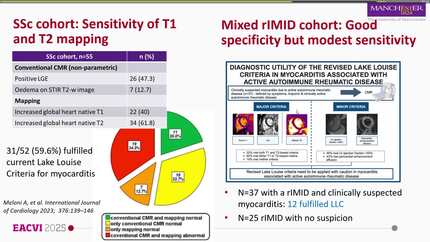
We reviewed 48 cardiac magnetic resonance imaging studies (mean age 43 years SD ±16 years, 42 women and 6 men), the most prevalent autoimmune diseases were: lupus erythematosus systemic (31.3%), mixed connective tissue disease (20.8%), rheumatoid arthritis (12.5%), antiphospholipid antibody syndrome (10.4%), systemic sclerosis (10.4%). The alterations found were late gadolinium enhancement (77.08%), valve disease (64.5%), decreased left ventricular ejection fraction (56.25%) and decreased right ventricular fraction (69%) and pericardium involvement (56%).
20.8% had a positive myocarditis protocol, of which 8.3% were chronic events/sequelae of myocarditis and 12.5% were acute events. T2W ratio ≥2 presented in 27.1%, without meeting the criteria for acute myocarditis and ruling out an acute ischemic event.
Due to its significant ability to detect myocardial damage, before cardiac dysfunction becomes clinically manifest, CMR is an excellent diagnostic tool for risk stratification and individualization of treatment in patients with autoimmune diseases.
Type of funding sources: None.
Contributors

M Chapa Ibarguengoitia
Author
S G Rosales Uvera
Author
M Sanchez Martinez
Author
A M Hurtado Duarte
Author
D Chango Azanza
Author
You may be interested in