Cardiac damage staging in patients undergoing TAVR. Incremental value of global longitudinal strain and right ventricular-arterial coupling
European Heart Journal


Abstract
Transcatheter aortic valve replacement (TAVR) is nowadays a safe and increasingly frequent option to treat severe aortic stenosis (AS). Cardiac damage staging has been proposed and validated in some studies as a prognostic tool; however, many patients continue to undergo aortic valve replacement only after there is evidence of cardiac damage. The aim of this study is to assess the potential incremental value of global longitudinal strain (GLS) and right ventricular-arterial coupling (RV-VAc) in the prognostic performance of the cardiac damage staging.
Consecutive patients with AS and undergoing TAVR were included in our hospital registry. Baseline echocardiography was performed before TAVR according to current guidelines. For this study, patients were classified based on the following stage of cardiac damage: Stage 0: no cardiac damage; Stage 1: left ventricular (LV) damage (LV ejection fraction (LVEF) <50%, LV mass index >95 g/m2 for women, >115 g/m2 for men); Stage 2: left atrial (LA) or mitral valve damage (LA volume index >34 ml/m2, mitral regurgitation moderate-severe, or presence of atrial fibrillation); Stage 3: pulmonary vasculature or tricuspid valve damage (systolic pulmonary artery pressure 60 mmHg, or tricuspid regurgitation moderate-severe); Stage 4: RV damage (TAPSE <1.7 cm, S' <9.5 cm/s).
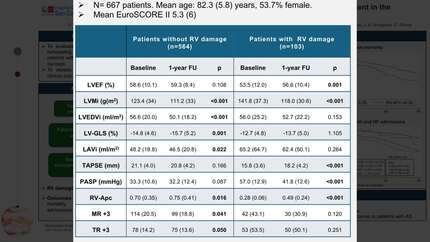
496 patients were studied. Mean age of the cohort was 81.9±6.2 years, mean aortic valve area was 0.86±0.6 cm2, mean LVEF was 57.9±12.3%, mean LV-GLS was −15.6±3.5% and RV-Vac was 0.61±0.34. Table 1 shows clinical and echo characteristics of patients. Only one patient (0.2%) met criteria for stage 0; 38 (7.7%) patients were in stage 1; 159 (32.1%) patients in stage 2, 157 (31.7%) patients in stage 3 and 141 (28.4%) patients in stage 4. 1-year mortality for stage 1 was (10.5%), for stage 2 (13.7%), for stage 3 (32.2%) and for stage 4 (19.5%). The area under the ROC curve (AUC) for 1-year mortality for the cardiac damage staging system was 0.622, CI (0.539–0.705); the best cut-off value for LV-GLS to predict 1-year mortality was −14% with an AUC of 0.634 CI (0.487–0.781) and RV-VAc had an AUC of 0.748 CI (0.638–858). Finally, the model that included the staging system, LV-GLS and RV-VAc had an AUC ROC of 0.875, CI (0.780–0.971) (Figure 1).
Cardiac damage staging is a good prognostic tool and it has been validated in several studies, however, the addition of feasible and widely available echo parameters such as LV-GLS and RV-VAc can significantly increase its prognostic yield.
Type of funding sources: None.
Table 1
Figure 1
Contributors

E Gutierrez
Author
I Carrion
Author
C Olmos
Author
P Jimenez
Author
L Nombela
Author
E Pozo
Author
P Mahia
Author
S Gil
Author
A De Agustin
Author
F Islas
Author
You may be interested in