Impact of persistent MVO late after STEMI on adverse left ventricular remodelling: a CMR study
European Heart Journal


Abstract
Despite successful revascularization at the epicardial level, microvascular obstruction (MVO) appears soon after reperfusion in up to 50% of cases. Early MVO has been solidly associated with adverse resulting cardiac structure and heightened risk of future cardiovascular events. Although clinical and experimental studies demostrated the spontaneous repair of MVO, little is known about the occurrence and implications of persistent MVO late after infarction.
We used cardiovascular magnetic resonance (CMR) to characterize the impact of persistent MVO late after reperfused ST-segment elevation myocardial infarction (STEMI) on adverse left ventricular (LV) remodelling (ALVR).
A prospective registry of 471 STEMI patients underwent CMR 7 [5–10] and 198 [167–231] days post infarction, and MVO (>1 segment) and ALVR (relative increase >15% at follow-up CMR) of LV end-diastolic (LVEDVI) and end-systolic volume indices (LVESVI) were determined.
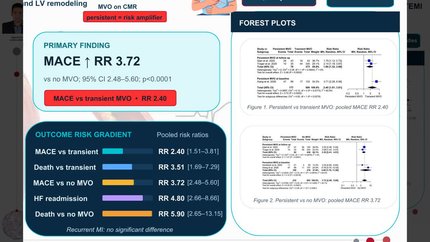
One-week MVO occurred in 209 patients (44%) and persisted in 30 of these (6%). Most patients with persistent MVO (22/30, 73%) displayed extensive (>2.5% of LV mass) MVO at 1 week. Compared with patients without MVO (n=262, 56%) or with MVO only at 1 week (n=179, 38%), those with persistent MVO at follow-up (n=30, 6%) showed higher rates of ALVR-LVEDVI (22%, 27%, 50% p=0.003) and ALVR-LVESVI (20%, 21%, 53% p<0.001). After adjustment, the extent (% of LV mass) of MVO at follow-up was independently associated with ΔLVEDVI (relative increase, %) (p=0.01) and ΔLVESVI (p=0.03). Compared to a 1:1 matched population of 30 patients with MVO only at 1 week, patients with persistent MVO more frequently displayed ALVR-LVEDVI (12% vs. 50%, p=0.003) and ALVR-LVESVI (12% vs. 53%, p=0.001).
MVO persists in a small percentage of patients in chronic phase after STEMI and exerts deleterious effects in terms of LV remodelling. These findings fuel the need for further research on microvascular injury repair.
Type of funding sources: Public grant(s) – National budget only. Main funding source(s): This work was supported by “Instituto de Salud Carlos III” and “Fondos Europeos de Desarrollo Regional FEDER” [grant numbers PI20/00637, PI15/00531, FI18/00320, and CIBERCV16/11/00486] and by Conselleria de Educaciόn – Generalitat Valenciana (PROMETEO/2021/008).
Contributors

J Gavara
Author
C Rios Navarro
Author
M P Lopez-Lereu
Author
J V Monmeneu
Author
E De Dios
Author
N Perez-Sole
Author
V Marcos-Garces
Author
J Canoves
Author
J Nunez
Author
F J Chorro
Author
J F Rodriguez-Palomares
Author
A Freixa
Author
R Borras
Author
J T Ortiz-Perez
Author
V Bodi
Author
You may be interested in