Edge-to-edge repair for tricuspid valve regurgitation. Preliminary echo-data from the Tricuspid Regurgitation IMAging (TRIMA) study
European Heart Journal


Abstract
The natural history of tricuspid valve regurgitation (TR) is characterized by dismal prognosis and high in-hospital mortality when treated with isolated surgery. We report preliminary procedural and echocardiographic results of our experience with the TriClip System in a cohort of “real-life” patients with functional tricuspid regurgitation.
From June 2020 to March 2022, 27 consecutive patients with > moderate TR have been screened, 12 underwent transcatheter TriClip repair. The anatomical feasibility was established through a complete transthoracic (TTE) and transesophageal echocardiogram (TEE), and a dedicated CT scan for the right cardiac chambers. The procedure was conducted under general anesthesia, guided by TEE and fluoroscopy.
A total of 12 subjects (83% female) with significant comorbidities and at high surgical risk were included. The mean age was 82±4 years with an average EuroSCORE II of 8.5±4%. TR included functional (75%) and (25%) mixed etiology (lead-induced and functional) and all patients were classified as at least NYHA functional class III. Nine patients (75%) had severe, two patients (17%) massive and one patient (8%) torrential TR.
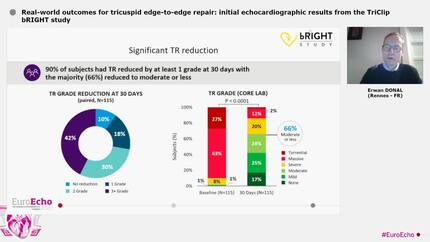
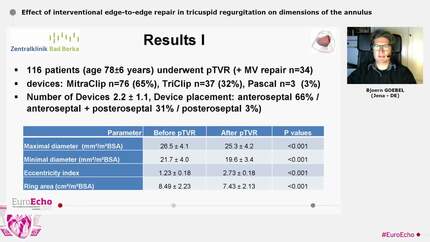
The implant and procedural success were achieved in all cases, implanting one device in 8 patients (67%) and two in 4 patients (33%). The device was positioned antero-septal in 83% (10of12) and postero-septal in 50% (6of12) of cases. A TR reduction of≥1 grade after procedure was achieved in all patients; 5 (42%) subjects had moderate, 6 (50%) mild, and one patient (8%) with previous torrential TR treated with two clips had severe post-procedural TR because of partial leaflet detachment 48-hours post-procedure. On TTE, significant reductions in effective regurgitant orifice area (0.61±0.28 to 0.31±0.22 cm2; p<0.001) and regurgitant volume (56.3±16.7 to 27.5±16.6ml; p<0.001) occurred between baseline and before hospital discharge. We also observed a significant reduction of tricuspid annulus diameter (43.8±5.6 to 39.8±4.2 mm; p<0.001), right ventricular basal diameter (47.2±6.8 to 42.9±4.5 mm; p=0.001), right atrial area (28.8±8.8 to 26.7±9.4 cm2; p=0.033). While 3 patients demonstrated a reduced TAPSE/PASP ratio (<0.31 mmHg) before the intervention, the overall ratio significantly improved after device placement (0.37±0.1 to 0.46±0.1 mmHg; p=0.011). At 30-days-follow-up, there was significant and sustained improvement in NYHA class with all patients reaching class II or less without additional reported hospitalizations.
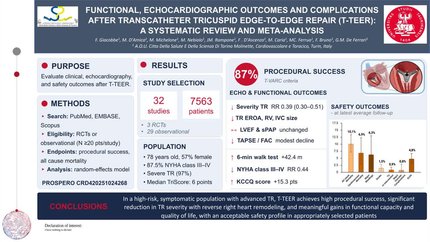
In this single center experience, we have shown that treatment with the edge-to-edge TriClip device is safe and effective and is associated with marked clinical benefits and reduced rates of hospitalizations. The resulting echocardiographic improvements indicate leaflet grasping does not just significantly reduce the grade of TR, but also affects adjacent structures and improves right ventricular afterload adaptation.
Type of funding sources: None.
Contributors

M Carpenito
Author
L Vitez
Author
V Cammalleri
Author
M C Bono
Author
S Mega
Author
A De Filippis
Author
E Nobile
Author
F Grigioni
Author
G P Ussia
Author
You may be interested in