Atrial functional mitral regurgitation during exercise is associated with impaired longitudinal left ventricular systolic function and annular dilation: an exercise echocardiographic study
European Heart Journal


Abstract
Atrial functional mitral regurgitation (AF-MR) has recently been recognized as a new disease entity in patients with atrial fibrillation (AF) and heart failure with preserved ejection fraction (HFpEF). This MR subtype is characterised by structurally normal leaflets, normal left ventricular size and mitral annular dilation. It is hypothesised that AF-MR results from mitral annulus area/leaflet area imbalance caused by annular dilation and impaired mitral annular dynamics, but precise mechanisms and determinants remain unclear. Also, very little is known about the influence of exercise.
To investigate the impact of exercise on the severity of AF-MR and to identify its determinants by exercise echocardiography.
Patients with HFpEF and/or AF were scheduled for a symptom-limited exercise echocardiography. We assessed mitral annular dimensions (antero-lateral diameter), AF-MR severity (multi-integrative approach), and parameters of systolic and diastolic function at rest and during maximal exercise.
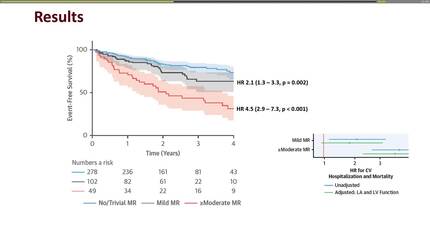
47 patients with HFpEF (n=39) and/or AF (n=22) were enrolled. As compared to rest, we noticed an increase in AF-MR severity of ≥1 grade in 20 patients (43%) during maximal exercise. Patients with progression of AF-MR at maximal exercise had significantly less progression of tissue Doppler-derived imaging peak systolic velocity at the medial mitral annulus (Med S') compared to patients without AF-MR progression (+1.1±1.7 cm/s vs +2.7±1.9 cm/s; p-value 0.005). This was accompanied by a greater systolic mitral annular diameter at maximal exercise (+0,5±4,2 mm), while the systolic annular diameter generally decreased in patients without AF-MR progression (−1,6±3,9 mm). Furthermore, patients with ≥moderate AF-MR during exercise (n=19; 40%) had lower Med S' (6.9±1.7 cm/s vs 8.9±2.6 cm/s; p-value 0.013), a greater systolic mitral annular diameter (26.0±4.3 mm vs 23.2±4.3 mm; p-value 0.042), reduced TAPSE (19.4±3.7 mm vs 24.3±3.2 mm; p-value 0.001) and a greater prevalence of ≥moderate TR (93% vs 45%; p-value 0.047) compared to patients with no or mild MR during exercise. No significant correlation was found between AF-MR severity at exercise and blood pressures, LVEF or parameters of diastolic function.
AF-MR is a dynamic condition which may worsen during exercise. Deterioration of AF-MR at maximal exercise was associated with impaired longitudinal left ventricular contractile reserve and greater mitral annular dimensions. As impaired left ventricular longitudinal function may influence systolic mitral annular dynamics, this attributes to the hypothesis that AF-MR results from mitral annulus area/leaflet area imbalance caused by both annular dilation and impaired mitral annular dynamics.
Type of funding sources: None.
Contributors

S De Schutter
Author
E Van Damme
Author
G Van Hout
Author
L L Pype
Author
M J Claeys
Author
C M Van De Heyning
Author
You may be interested in