Clinical utility and prognostic value of right atrial function in severe tricuspid regurgitation. One more piece of the puzzle
European Heart Journal


Abstract
Optimal management of severe tricuspid regurgitation (TR) remains controversial. While right ventricular systolic function is an established prognostic marker of outcomes, the potential role of right atrial (RA) function is unknown.
This study was aimed to describe RA function by 2D speckle tracking echocardiography (STE) in severe TR and to evaluate its potential association with cardiovascular outcomes
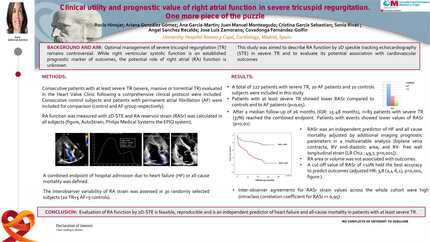
Consecutive patients with at least severe TR (severe, massive or torrential TR) evaluated in the Heart Valve Clinic following a comprehensive clinical protocol were included. Consecutive control subjects and patients with permanent atrial fibrillation (AF) were included for comparison. RA function was measured with 2D-STE and 3 components of RA function were calculated: reservoir (RASr), conduit (RAScd) and contractile (RASct) RA values using an automatic 2D strain analytical software (AutoStrain, Philips Medical Systems the EPIQ system, Figure 1). A combined endpoint of hospital admission due to heart failure (HF) or all-cause mortality was defined. The interobserver variability of RA strain was assessed in 30 randomly selected subjects (20 TR+5 AF+5 controls).
A total of 176 patients with severe TR, 20 AF patients and 20 controls subjects were included in this study. Patients with at least severe TR showed lower RASr and RAScd compared to controls and to AF patients (Figure 1 and Table 1, p<0.05). After a median follow-up of 28 months (IQR: 15–48 months), n=65 patients with severe TR (37%) reached the combined endpoint. 65 (37%) were admitted for right heart failure and 8% of the population (n=14) died. Patients with events showed lower values of RASr and RAScd (p<0.01 for both). Between both parameters RASr was more strongly associated with outcomes compared to RAScd (AUC 0.74 vs. 0.65, p<0.01). RASr was an independent predictor of heart failure and all cause mortality adjusted by additional imaging prognostic parameters in a multivariable analysis (biplane vena contracta, RV end-diastolic area, and RV-free wall longitudinal strain [LR χ2: 49.7, p<0.001]). RA area or volume was not associated with outcomes. A cut-off value of RASr of <9.4% held the best accuracy to predict outcomes (adjusted HR 3.2 (1.81–5.84), p<0.001, Figure 1). Inter-observer agreements for RA strain values across the whole cohort were high (intraclass correlation coefficient for RASr, RAScd and RASct, r=0.95, r=0.86, r=0,92 respectively)
Evaluation of RA function by 2D-STE is feasible, reproducible and is an independent predictor of heart failure and all-cause mortality in patients with at least severe TR.
Type of funding sources: Public grant(s) – National budget only. Main funding source(s): INSTITUTO CARLOS III
Figure 1
Table 1. RA strain in controls, AF and TR patient
Contributors

R Hinojar Baydes
Author
A Gonzalez-Gomez
Author
A Garcia-Martin
Author
J M Monteagudo
Author
I Garcia-Lunar
Author
S Rivas
Author
M A Sanroman
Author
A Pardo
Author
J J Jimenez-Nacher
Author
A Sanchez-Recalde
Author
J L Zamorano
Author
C Fernandez-Golfin
Author
You may be interested in