Impact of recent 2021 ESC guideline changes on postoperative survival of patients with severe aortic regurgitation: insights from the AVIATOR registry
European Heart Journal


Abstract
Until 2021, the strongest guidelines on surgical correction of severe aortic regurgitation (AR) focused on the left ventricular systolic function (LVEF) and the presence of symptoms. However, those situations lead to an outcome penalty, even after surgical correction. Left ventricle end-systolic diameter (LVESD) gained in strength in 2021 European guidelines. Moreover, more inclusive cut-off values are now recommended (class IIb) in patients at low surgical risk, reflecting the will to recommend surgery before developing heart failure and its consequences on post-operative outcome.
We sought to evaluate the impact of guidelines triggers and their recent changes on postoperative survival of patients with severe AR from a large multicentric international registry.
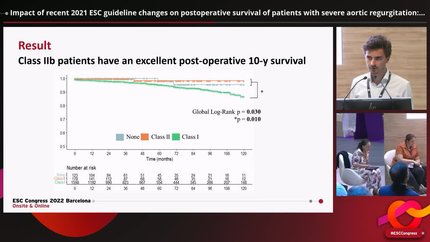
Postoperative overall survival of 1899 patients operated for severe and chronic AR (mean age 49±15 years, 85% male) in the international multicenter surgery registry for aortic valve surgery, AVIATOR, was evaluated over a median of 37 months. Twelve patients (0.6%) died postoperatively, and 68 within 10 years. By multivariable Cox analysis, presence of heart failure symptoms (HR 2.60; 95% CI [1.20–5.66]; p=0; 016), and either LVESD >50 mm or >25 mm/m2 (HR 1.64; 95% CI [1.05–2.55]; p=0.029) predicted survival independently over and above age (HR 2.25 per SD, 95% CI [1.67–3.03], p<0.001), female gender and bicuspid phenotype. Therefore, patients operated on when meeting either old or new 2021 class I triggers had worse adjusted survival (respectively 86±2% and 87±2%) than patients operated on without meeting triggers (97±2%, p<0.01). However asymptomatic patients operated on while meeting new 2021 ESC class IIb triggers (ie LVESD >20 mm/m2 or LVEF between 50–55%, 10-year survival 97±3%). Moreover, the sub-group of patients having a dilated LVESD >50 mm or >25 mm/m2 but a preserved LVEF >50% had excellent survival (10-year survival 95±3%).
In severe AR, patients operated on when meeting any class I trigger have postoperative survival penalty. Asymptomatic patients operated on earlier have better survival. This supports early surgery in AR as encouraged by the recent ESC/EACTS guidelines.
Type of funding sources: Public grant(s) – National budget only. Main funding source(s): Fondation Nationale de la Recherche Scientifique of the Belgian Government
Figure 1. Multivariate Cox model of overall post-operative survival.
Figure 2. Post-operative survival according to ESC/EACTS 2021 trigger.
Contributors

V Hanet
Author
D De Azevedo
Author
P Krug
Author
H J Schafers
Author
E Lansac
Author
L De Kerchove
Author
I El-Hamamsy
Author
J Vojacek
Author
M Contino
Author
A C Pouleur
Author
C Beauloye
Author
A Pasquet
Author
J L Vanoverschelde
Author
D Vancraeynest
Author
B Gerber
Author
You may be interested in