Left atrial reservoir strain is an independent prognostic predictor in patients undergoing percutaneous mitral valve repair
European Heart Journal


Abstract
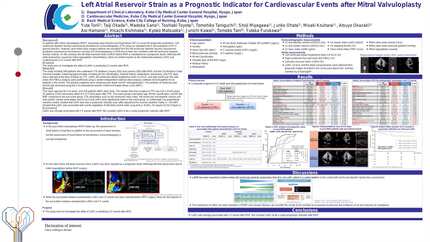
Left atrial reservoir strain (LARS) is a well known prognostic predictor in several cardiac disease. Aim of the study was to assess the value of LARS in predicting the occurrence of major adverse cardiovascular events in patients undergoing percutaneous mitral valve repair (PMVR)
112 patients (62 males, mean age 74 years) undergoing PMVR for severe primary (n=71, 63%) or secondary MR were retrospectively included in the study. All patients underwent a comprehensive echocardiography before the procedure. Thirty-eight MACES occurred during a median follow up of 18 months. At multivariable Cox regression analysis, ischemic cardiomyopathy (CAD) [HR: 2.41 (1.11–5.24) p=0.02], indexed left atrial volume (LAVi) [HR: 1.01 (1.00–1.01) p=0 03] and LARS [HR: 0.93, (0.88–0.99) p=0.03] were all significant predictors of MACEs (Table 1). A cut-off of 13 for LARS (AUC 0 66 p=0.008 was able to predict MACEs with a 71% sensitivity and 41% specificity (Figure 1A). At Kaplan Meier analysis a PLAS <13% was associated with a worse prognosis (Log rank p=0.01) (Figure 1B).
LARS is an independent predictor of MACEs in patients undergoing percutaneous mitral valve repair, independently of the etiology of mitral regurgitation.
Type of funding sources: None.
Table 1
Figure 1

You may be interested in