Acute and chronic changes in LV performance in patients with primary severe mitral regurgitation undergoing percutaneous mitral valve repair
European Heart Journal


Abstract
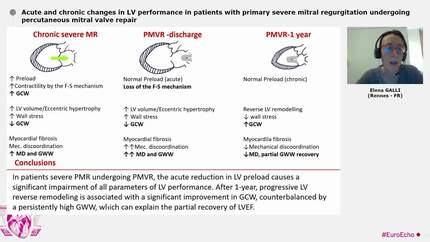
The non-invasive assessment of myocardial work allows to evaluate LV performance by taking into account the effect of LV load. Aim of this study was to evaluate the acute and chronic impact of percutaneous mitral valve repair (PMVR) on LV performance, in patients with severe primary mitral regurgitation (PMR).
71 patients (age: 77±9 years, females: 44%) with severe PMR (effective regurgitant orifice: 0.57±0.31 cm2, regurgitant volume: 80±34 ml) and preserved LV ejection fraction (LVEF: 60±10%) underwent PMVR according to current recommendations. Myocardial work indices were evaluated before the procedure, 2 days after the procedure and at 1-year follow-up.
PMVR was associated with an acute reduction in LVEF, global longitudinal strain (GLS), myocardial work index (MWI), and work efficiency (MWE), and a significant increase in myocardial wasted work (MWW) and mechanical dispersion (MD). 1-year after the procedure, LV size significantly decreased, GLS, MWI, MWE and MD improved, whereas GWW remained significantly reduced. LVEF improved but remained significantly altered compared with baseline values (Table 1).
In patients severe PMR undergoing PMVR, the acute reduction in LV preload causes a significant impairment of all parameters of LV performance. After 1-year, progressive LV remodeling is associated a significant improvement in MCW, counterbalanced by a persistently high MWW, which can explain the partial recovery of LVEF.
Type of funding sources: None.
Table 1
Contributors

You may be interested in