Supra-normal values of resting left ventricular systolic function are associated with decreased survival: to good to be normal?
European Heart Journal


Abstract
Hyper-contractile phenotype of the left ventricle (LV) is generally considered prognostically benign, but recent data challenge this intuitive assumption.
To assess the effects of resting LV function on survival.
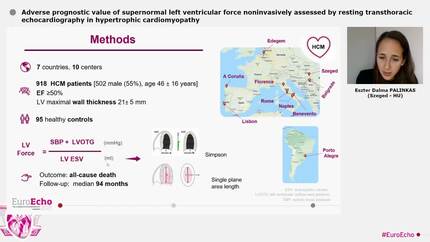
In a prospective, observational, multicenter study, we recruited 5,122 patients (age 65±11.1 years, 2974 males, 58%) with chronic coronary syndromes referred for resting transthoracic echocardiography with technically successful volumetric echocardiography in 14 accredited laboratories. All recruiting centers had a structured follow-up program with >90% follow-up rate. In each patient, we quantitatively assessed (by Simpson's biplane, apical single-plane or parasternal linear method) LV end-diastolic volume (EDV), end-systolic volume (ESV), and ejection fraction (EF). As a load-independent index of LV contractility, LV force was estimated as systolic blood pressure by cuff sphygmomanometer/ESV. All-cause death was the only considered outcome end-point.
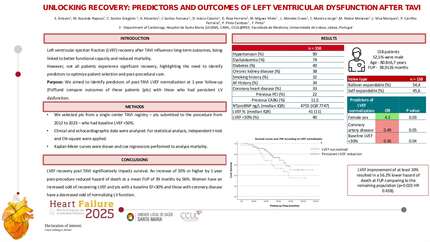
EF was 59±11% (normal reference sextile = 58.0–59.9%). Force was 4.51±2.11 mmHg/ml (normal reference sextile = 3.50–4.27 mmHg/ml). The correlation between EF and force was linear (r=0.585, p<0.001). After a median follow-up of 862 days, there were 265 all-cause deaths. Considering EF values, mortality was lowest in the highest sextile (>67%) and significantly higher in the lowest sextile (EF <52%): see figure, left panel. A U-shaped curve was found with force, with mortality values being lowest in the middle sextile and significantly higher in the lowest sextile (<2.59 mmHg/ml) and in the highest sextile (>6.36 mmHg/ml): see figure, right panel. At multivariable analysis, after adjustment for age, diabetes, EF, and prior myocardial infarction, both the highest sextile of force (HR 1.84, 95%, confidence intervals 1.12–3.03 p=0.015), and the lowest sextile of force (HR 1.77, 95%, confidence intervals 1.08–2.90 p=0.024) were associated with decreased survival.
Sub-normal values of resting ejection fraction and super- and sub-normal values of the force are associated with worse survival in patients with chronic coronary syndromes. This U-shaped curve of mortality is detectable only with the force, a load independent index of LV contractility: too much of a good thing such as LV contractility can be dangerous on the long-run.
Type of funding sources: None.
Contributors

C C De A Bellagamba
Author
Q Ciampi
Author
T Bombardini
Author
L Cortigiani
Author
A Zagatina
Author
K Wierzbowska-Drabik
Author
J D Kasprzak
Author
M Amor
Author
A Djordjevic-Dikic
Author
A Boshchenko
Author
H Rodriguez Zanella
Author
N Gaibazzi
Author
M Pepi
Author
E Picano
Author
You may be interested in