Left atrial reservoir strain predicts ischemic stroke after coronary artery bypass grafting independent of postoperative atrial fibrillation
European Heart Journal


Abstract
Patients undergoing coronary artery bypass grafting (CABG) surgery face an elevated long-term risk of ischemic stroke.
Left atrial (LA) mechanics including LA strain are known to predict both stroke and atrial fibrillation in other populations. Evidence is conflicting with regards to the clinical significance of postoperative atrial fibrillation (POAF) and its role in the association between LA mechanics and ischemic stroke is unclear.
The aim of the study was to investigate the association between LA reservoir strain and long-term ischemic stroke in patients undergoing CABG surgery and whether the presence of POAF modified this relationship.
Patients undergoing isolated CABG were included from 2006–2011 as part of a retrospective cohort study. Echocardiography was performed prior to surgery. We included patients with available LA reservoir strain measurements, while patients with known atrial fibrillation and moderate to severe valvular disease were excluded. The primary endpoint was ischemic stroke. The association between LA reservoir strain and ischemic stroke was investigated in uni- and multivariable Cox proportional hazards regression models including adjustment for POAF. Poisson regression was used to create a restricted cubic spline model of the continuous association between LA reservoir strain and risk of ischemic stroke.
We included 542 patients in the analysis. Mean age was 67.3±8.9 years, 89 (16.4%) were female, and median EuroSCORE II was 1.31 (IQR 0.93–1.96). Patients with LA reservoir strain <27.2% (median) were older, more likely to have diabetes, and had a higher EuroSCORE II.
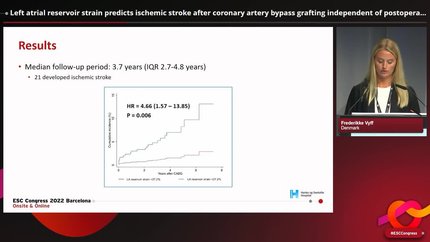
In total, 96 patients (17.7%) developed POAF. During a median follow-up period of 3.7 years (IQR 2.7–4.8 years), 21 (3.9%) patients experienced ischemic stroke. In univariable modeling, LA reservoir strain was significantly associated with ischemic stroke (HR 1.10 (95% CI 1.03–1.18, p=0.003) per 1% absolute decrease). After adjustment for EuroSCORE II, LA volume index (LAVi) and prior stroke, LA reservoir strain remained a significant predictor of ischemic stroke (HR 1.09 (95% CI 1.02–1.17, p=0.011) per 1% absolute decrease and HR 4.24 (95% CI 1.37–13.10, p=0.012) for < vs. >median). Adding POAF as a covariate did not alter the significance of LA reservoir strain in the model. In addition, POAF did not modify the association between LA reservoir strain and POAF (p for interaction = 0.07). The association between LA reservoir strain and ischemic stroke persisted in multiple sensitivity analyses including restricting the analysis to patients with normal left atrial volumes (LAVi <34 ml/m2), patients without POAF, and when excluding patients who developed atrial fibrillation during follow-up.
In patients undergoing CABG, LA reservoir strain was an independent long-term predictor of ischemic stroke. The predictive value of LA reservoir strain was unaffected by the presence of POAF.
Type of funding sources: None.
Contributors

F Vyff
Author
N D Johansen
Author
F J Olsen
Author
L S Duus
Author
S Lindberg
Author
T Fritz-Hansen
Author
S A Haahr-Pedersen
Author
A Z Iversen
Author
S Galatius
Author
R Mogelvang
Author
T Biering-Sorensen
Author
You may be interested in