Left atrial strain analysis improves non-invasive estimation of left ventricular filling pressures in takotsubo syndrome
European Heart Journal


Abstract
Takotsubo syndrome (TTS) is associated with a non-negligible risk of in-hospital (IH) complications. Elevated left ventricular filling pressures (LVFP), measured invasively as LV end-diastolic pressure (LVEDP), showed to predict adverse IH outcomes in this population.
Recently, novel indexes of left atrial (LA) function, including LA reservoir and LA pump strain, demonstrated a close correlation with increased LVFP in unselected patients.
To assess the ability of LA reservoir and LA pump strain to improve non-invasive estimation of LVFP and to predict IH complications in TTS patients.
We retrospectively enrolled patients with confirmed TTS diagnosis at invasive left heart catheterization and coronary angiography. LVEDP was assessed invasively at the time of catheterization. Transthoracic echocardiography was performed with 48 hours from hospital admission. IH complications were collected, including occurrence of acute heart failure (pulmonary oedema/cardiogenic shock; Killip class III/IV), death from any cause and life-threatening arrhythmias.
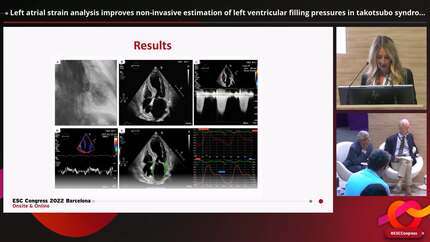
A total of 62 patients were analysed (72.2±10.1 years, female 80%). IH complications occurred in 25 (40.3%). Patients who experienced IH complications had higher LVEDP and lower LVEF, LA reservoir strain and LA pump strain values compared to patients without IH complications (all P≤0.001). At multivariate analysis, EF and LVEDP were independent predictors of worse IH outcomes (P≤0.001 and P=0.004 respectively). Correlation analysis proved that lower values of both LA reservoir and pump strain were associated with increasingly higher LVEDP (r −0.859, P≤0.001 and r −0.848, P≤0.001 respectively). Receiving operating characteristic (ROC) curve analysis showed that the AUC for LVEDP to predict IH complications was 0.814 (95% CI 0.679–0.949, P≤0.001) with an optimal cut-off value of 24.5 mmHg (sensitivity 77%, specificity 53%).
Therefore, we performed ROC curve analysis to compare the ability of LA strain values and standard echocardiographic parameters currently used for non-invasive LVFP assessment to predict LVEDP ≥24.5 mmHg. As a result, we obtained higher AUC for LA reservoir and pump strain [0.909 (95% CI 0.818–0.999, P≤0.001) and 0.889 (95% CI 0.789–0.988, P≤0.001), respectively] vs E/e' 0.800 (95% CI 0.663–0.937, P≤0.001), LAVi 0.666 (P=0.092) and tricuspid regurgitation (TR) peak velocity 0.582 (P=0.596). The incorporation of LA strain values in a multivariable model including E/e' ratio, LAVi and TR peak velocity to predict a LVEDP ≥24.5 mmHg led to a significant incremental predictive value (changes in χ2=11.99; P=0.002).
In patients with TTS, lower LA reservoir and pump strain values correlate with increased LVEDP and improve non-invasive estimation of LVFP. LA strain analysis may be an easy tool to individuate subjects at higher risk of IH complications.
Type of funding sources: None.
Figure 1. Central figure
Figure 2. ROC curve analysis
Contributors

G Iannaccone
Author
F Graziani
Author
M G Del Buono
Author
M Camilli
Author
R Lillo
Author
A Caffe'
Author
G La Vecchia
Author
R Rinaldi
Author
D Pedicino
Author
T Sanna
Author
C Trani
Author
A Lombardo
Author
G A Lanza
Author
R A Montone
Author
F Crea
Author
You may be interested in